Stray dogs in Ultra Races – Some ideas from a rider who doesn’t cuddle dogs

If you’re super confident with dogs, everything I’m writing here may be obvious and nothing new to you. If you’re a bit like me, the following comments may help you handle your dog-anxiety prior to and during an Ultra Race.


The 9th edition of The Transcontinental Race is coming up this Sunday, 23rd of July 2023. I realized, like every year the topic of stray dogs and how to handle them is on the minds of many fearful riders. So I thought I’d share some of my experiences; the learnings definitely helped me a lot. I rode two TCR editions (6 & 8). Dogs were a major worry for me prior to each of those races. In TCR No 6 they turned out to be one of my worst nightmares – but: mostly because of my own mental state towards them (you can read a bit in this interactive map of my TCR06; you can check the “adversity” markers on the map in Albania). In TCR No 8 I was worried in advance, but ultimately got a really good grip on stray dogs because I suddenly understood a few things about them…

I divided my thoughts into a few paragraphs:

  • Before we start…
  • 1. The psyche of a dog – Be a master, not prey.
  • 2. The best tip I got… show dominance.
  • 3. Show them you’re a human.
  • 4. Get off the bike – bring a stick.
  • 5. Escape sprint
  • 6. Middle of the road…
  • 7. Where are they?
  • 8. Night and day
  • 9. Mind-games
  • 10. Other tools & methods
  • Conclusion

Some DISCLAIMERS:

  • I did not grow up with any pets, I have no clue how to interact with dogs, and try to avoid interacting with any (even pet) dog at almost all costs. So my thoughts may be more helpful to those who have a similar relationship with dogs/animals. Those who have more intimate familiarity with dogs may have entirely different strategies in their toolbox, and certainly everyone will find their own approach.
  • Obviously I’m not a dog-whsiperer, evolutionary psychologist, or the like. So my inferences about the inner workings of dogs’ “minds” are just (to me) plausible speculation.
  • Obviously: I provide no guarantees for the effectiveness of my approaches. : D Maybe my post inspires you a bit, but I won’t pay for your post-hoc rabies vaccination hah.
  • I sincerely respect and admire all animals. Even the stray dog that chases me down at night. As you will read I’m sorry for them to be wired to annoy us in certain moments; it’s a consequence of the marvel that is biological evolution. I hope all dogs live a comfortable life, and that here and there a salami falls out of a rider’s food pouch.

I’m talking stray dogs here. This does NOT apply to shepherd dogs; and neither to guard dogs. The former (shepherd dogs) will have a very clear task set to defend their herd and territory; and can become dangerous at that. Luckily, I have no experience with them, so will not give any tips. The latter (guard dogs) will not chase you far beyond the immediate real estate they belong to, and will often be behind fences or on leashes anyway; i.e.: might induce a little adrenaline rush until you out-sprinted them or realise they cannot get close to you anyway.


Before we start…

…keep in mind: Stray dogs may be a major worry in advance of the race. But you will find out they will not define your experience of the ride – I hope I can contribute to that. And secondly: once you now thought about some dog-strategies, make sure to forget about the dogs until you encounter one; you will handle the situation then. And who knows: maybe you will not even have a single dog encounter!

1. The psyche of a dog – Be a master, not prey.

This is the most important principle I realized, and almost all practical tips are derived from this: Dogs are primed to chase prey. They *might* put you in the “prey” category instinctively. In that case they probably can’t resist their inner urge to chase; I feel mostly chasing is where it ends and based on my encounters got the impression they do not want the ultimate confrontation. I feel a bit sad for dogs to be slaves of their instincts in that way. Anyway: Show them you’re a human and you’re their master, or at the very least: nothing they should dare to chase. You are no prey – you are in charge.

2. The best tip I got… dominance.

In Romania last year, a kind dot watcher, Cosmin (hello, of you read this!), waited for me and joined me for a few km at the Northern edge of urban Râmnicu Vâlcea. Seeing how he as a local handled the dogs was eye-opening: Whenever a dog was starting to move up from the pavement, he – in a relaxed way – got into an upright position, very quickly/forcefully pointed his arm and finger at the dog and shouting “hey”, “stop” and the like (almost sounding like a bark) in a very confident (not fearful-sounding) voice. DOMINANCE was the message. The dogs stopped even before they really chased. He did so while holding a conversation with me. Effortless and internalized.

It was evening, and I used this trick to get through the night. Over the next hours it became a habit. It really worked 90% of the time and as soon as I realized how effective it was it gave me so much peace of mind that other worries became more important. So empowering and such a relief to have one worry less.

3. Show them you’re a human.

Firstly, keep in mind: at night, dogs don’t see YOU. They see two obscure lights (red and white) flashing by exactly at their chase pace. All they can do is give in to their instincts. Using your voice, to let them know you’re human, or at least a very powerful creature will often make them aware you’re nothing for them to chase; as mentioned in #2.

But even in daylight you may not immediately be recognizable as a human (I don’t know). You move in an oddly fluent way, you’re a strange creature made up of a unit with your bike. Only things like your voice, gestures of your arms or getting off your bike will reveal you as the class of animal that you are: a human, i.e. someone to obey or otherwise fear.

4. Get off the bike – bring a stick.

I once made my way past a pack of Romanian dogs that wanted to defend their territory at an abandoned railway station. I think I did not really enter their territory, but the dogs came closer, barking loudly, just to make sure to chase me away. Following some advice I heard, I collected a stick/branch that I carried with me to get past the pack (about 1m long, stable). I used it whenever a dog seemed to want to come closer. Waved with it, pretended to be ready to hit. The stick made me look larger, and exaggerated my movements, and I heard stray dogs’ sad experience with human violence conditioned them to fear sticks. It had a clearly deterring effect. Not sure I would have gotten through it without. I combined this with the commands/shouts from #2.

In that situation I also walked. Got off my bike, keeping the bike on the side facing the dogs (i.e. between dogs and me). That way they saw I was a human, and I felt a bit protected with my bike as a (at least mental) barrier.

Getting off your bike is a tip you hear a lot. I’m convinced it’s effective in many situations. But to me it’s not easy to do mentally. I’m just not confident enough. I did it a few times, and found it challenging to then get back on the bike without the dogs getting aggressive again. If you practice it and realise it works for you: use that skill.

Cycling very slowly (walking pace), and not pedalling, is a way, too. I only did that once; ironically for the first time 13km before the finish-line in Meteora (so joyfully anticipating my finish, I didn’t even care about anything else anymore). It was on an uphill where I couldn’t sprint off. The dog came closer, sniffed, and went off. Had I just known earlier that it go this way… would have saved me many worries (see #8).

5. Escape sprint

Honestly… found it super effective so many times. Only works when it’s flat or downhill, obviously. Mostly dogs don’t chase you for long. If they get close during the sprint, I had the impression they either don’t want to really get you, or the whole mechanics of the situation doesn’t allow them to actually reach you (moving pedals, they have to move inwards, losing speed, etc.).

In TCR06 this was my main method to handle dog encounters. In TCR08 I used mostly the gesture+shout (#2), but when it didn’t work a few times, or when I saw the dog too late, I sprinted.

Whether it’s your preferred method, or just a means of last resort… it can be a legit way to get out of it.

6. Middle of the road…

No, not the figure of speech, but literally: cycling in the middle of the road – i.e. keeping a distance from the edge of the road where dogs chill – gives you a head start, safe distance and a good overview when observing the side of the road. Of course: only when traffic allows! I used it on empty roads in Albania and Romania in the night, and here and there during the day.

7. Where are they?

Some awareness of where stray dogs are mostly found, and where of those places they are harmless or not, can help your peace of mind, too:

On the MACRO scale: Of the west balkan countries found stray dogs problematic only in Albania. Somehow in Croatia & Bosnia didn’t have any issues. Might have been a coincidence though; I’ve heard of unpleasant encounters even as North as Croatia. Generally the more south you get in the West-Balkans, the more likely dog encounters are, based on my experience. In Serbia I also had no dog issues, even during the nights. Also locals confirmed there were not really issues with dogs in western Serbia (where I entered from Montenegro). In the East-Balkans Romania was full of stray-dogs (mostly in/around small settlements and edges of cities) while I didn’t encounter any in Bulgaria (neither day nor night, neither cities nor countryside)

I strongly advise you: talk to locals if stray dogs are a problem. It can a) give you valuable information, and b) some piece of mind. Once I asked a gas station clerk in Northern Bosnia. He said: “no dogs”… that simple exchange made my following night & day in Bosnia so much more relaxed. Whether it was true or not : D

On the MESO scale (as rules of thumb!):

  • Urban centers: Rather don’t worry. Often many dogs, but they don’t care about you because they’re too used to oddly moving humans and vehicles and probably they cannot have their own territories anyway.
  • Suburbs/edges of cities: Be more alert. Stray dogs like the proximity to settlements. Here they are less disturbed by humans, can be more territorial because there’s space, and they find a lot of waste from the urban civilization to live on. All those reasons are my speculation, but the effect (more problematic stray dogs) is a fact.
  • Remote countryside: Mostly no need to worry. Except for the occasional farm (guard dogs, shepherd dogs) or small settlement (stray dogs). In those instances: be awake and alert. Otherwise: enjoy the flow through the day or night.

On the MICRO scale:

  • on your heels.

8. Night and day…

Night and day… makes a huge difference. My greatest dog horrors (perceived or real) occurred during nights (again: Albania 2018), certainly for the reasons explained in #3 – dogs will not recognise you as a human, and will be forced to give in to any instincts triggered by any little peak of activity (i.e. you zipping by) during this low-sensory time of the 24h-cycle. And on your part: at night you will simply see less, are less able to anticipate the layout and change of scenery, are probably a bit tired and generally have less grip on what’s going on. So: use your ears, but also #7: evaluate how likely it is for dogs to be present. And if you encounter one, use your voice and sounds to present yourself (#3). And keep cool – don’t give in to the mind-games (#9).

During the day however I by now feel dogs are hardly an issue. You see more, they recognise you better. And also: In the midday and afternoon heat of the balkans I felt dogs are less agile. You can often already see it by the way they sluggishly roam along the road: this dog doesn’t care about you.

9. Mind-games

Back in Albania in 2018 when I had no previous stray dog experience, my anxiety had two origins: On the one hand, real encounters, especially right after the border from Montenegro, at night, where I had many encounters and chases. On the other hand, and much more importantly, I terrorised myself by always being alert, being hyper-sensitive to any sound, any corner, the darkness. Always expecting something, because due to my lack of experience everything was uncertainty and it felt like the next chase was just around the corner. So after the first night with encounters, the fearful imagination and anticipation dominated my perception, while I had literally no new encounters. It’s a mental thing; if I had just known some of the things back then, it would have made for a much more comfy ride. Be alert in the right moments, and relax everywhere else.
Sleep-deprivation, exhaustion, heat, traffic… all that certainly wasn’t helpful calming my mind.

10. Other tools & methods

In the many discussions of the topic (e.g. TCR Facebook group) I found many more ways how people (think they could) handle stray dogs. If you think any might work… try it!

The methods I gave you above are mostly designed to establish a power dynamic between the dog and you so in the best case there’s no close encounter happening in the first place. Here you find methods that have more a character of actually “fighting” the dog:

Sound-emmitting devices: I heard Christoph Strasser used some electronic sound device effectively on his TCR08 win. I don’t know what he used. But maybe it’s the miracle solution?
Referee whistle… curious if that works. I doubt it, and suspect it’s most damaging to your own ears as they are closer to the whsitle than the dog and the whistle lies exactly within the audible frequency spectrrum for your ears (ultimately: they’re designed to be audible by humans, not dogs) .

Flash/Strobe-Light: Not sure how that works. Could imagine it makes dogs even more aggressive. And could maybe harm your own orientation, too? Let me know.

Pepperspray: While I did bring a small can on TCR06, also didn’t try that one. You’d need to let the dog come close to you to first apply it and then see if it worked. I suspect it’s not effective quickly enough for that 1 meter distance you have between yourself and the dog by that point. Also, if theres a breeze against you, you’ll get it into your own eyes. I suspect it’s more difficult to handle effectively than one might imagine.

Pebbles: bringing pebbles to (pretend to) throw at dogs. Heard that one a while back. My view is: a) it’s not nice to throw rocks at dogs and probably hurt them. Their life on the road is often miserable already the way it is. b) I wouldn’t want to carry pebbles all the time just in case. And then restock because one dog made me use them all. However, c) some say it would be sufficient to pick up a pebble without throwing it, or even just pretending to reach for a pebble; because allegedly stray dogs know the gesture as a threat from past abuse. This last point may make it viable but probably not reliable.

Spray with your bottle: heard this a few times now. Try it out! If it works it may neatly complement the other measures I suggest.

And lastly a (seemingly) more peaceful method:

Bring treats: some people say to bring little sausages. In my view they are romanticising both dog encounters and food logistics on a race; honestly, often it sounds as if they’ve never actually had or did one. I’d fear to give dogs even more reason to chase me, and: I’d only find out if it works by letting them close to me. Or throwing the sausages or something… too much uncertainty. And practically, you’ll be happy if you manage to keep your own fuel supply in check; bringing extra sausages is a burden you will likely not want to take on.
So: I’m sceptic, but let me know. If – as opposed to me – you’re one of those dog-whisperer people: go ahead!

Conclusion

Now I’ve talked a lot about dogs. It may give the impression they’d be a super big deal; but in fact I was just focussing on a very niche element of your Ultra Race experience. Actually, I hope my comments – all based only on my personal experience, and some lose inferences – can help some of you anticipate the dog issue with a bit more peace of mind, maybe one or the other tip helps you go as smoothly through your dog encounters as I did in Romania on TCR08, and ultimately: I hope my little contribution pushes the topic of dogs even further into a background niche within your racing experiences and (as importantly) memories you make.

Enjoy the ride!

PS: if you have substantially different ideas, let me know in a comment here! Or post it in some discussion forum to share it with other riders.

UPCOMING: Köln, So. 9.7.23 – Vortrag beim “Travel Slam” im Open-Air-Kino Köln (in German)

[in German only]

Am
So, 9. Juli 2023, 20:15h
Open-Air Kino Rheinauhafen
Harry-Blum-Platz 1
Köln, 50678

(GoogleMaps)

bin ich zum 2. Mal eingeladen beim sogenannter “Travel Slam” zu sprechen: 3 Vorträge von 3 Reisenden. Am Ende wählt das Publikum den Favoriten und es gibt eine Bonus-Runde. In diesem Falle sind wir alle 3 die Gewinner aus vorigen Runden.

Ich werde 15 Minuten lang mit Bildern von meinem Transcontinental Race No. 8 (2022) erzählen. Außerdem tragen vor: Thomas Finke (Island mit dem Motorrad) und Sebastian Geißler (Sumatra). Ich bin gespannt und freu mich drauf!

Eintritt: 10€, auch Abendkasse (die gehen nicht an mich)
Weiter Infos und Anmeldung: hier www.travelslam.de

Malte Hager • Maltes Transcontinental Race | Köln, 02.02.2023

– 4200 km mit dem Reise-Rennrad durch Europa

Einen Kontinent durchqueren in 2 Wochen… 4200km und zigtausend Höhenmeter von Brüssel ans schwarze Meer; mit dem Fahrrad und ohne Hilfe von außen. Malte Hager wird von seinem abenteuerlichen Transcontinental Race berichten: Einem der renommiertesten Ultra-Langstreckenrennen der Welt, das er im Sommer 2022 absolvierte.

Mit minimalem Gepäck, eher stringenter Vorwärtsbewegung, glitzernden Alpenpässen, Osteuropäischer Bergwildnis, Mikro-Begegnungen, ungekanntem Schmerz, Hundejagden, menschlicher Verbundenheit, Rausch und Rührung: Bei dieser Ausnahmeerfahrung konnte Malte sehen wie die vielfältige Landschaft und Kultur Europas innerhalb kurzer Distanzen variiert und wie auch der eigene fluktuierende körperliche und mentale Zustand zu jedem Zeitpunkt wenig Gewissheit über den weiteren Verlauf des Radreiserennens gibt.

Malte wird erzählen wie er auf diesen Irrsinn kam, wie das Rennen verlief und sich anfühlte und was ein Baseballschläger und Lebkuchengebäck damit zu tun haben.

Homepage: www.cyclingtourist.com
Instagram: @maltecyclingtourist

Rückblick & Videos: 2.2.23 – Vorträge beim “Travel Slam”, Köln (German)

[in German only]

Videos zu meinen Vorträgen gibt es unten.

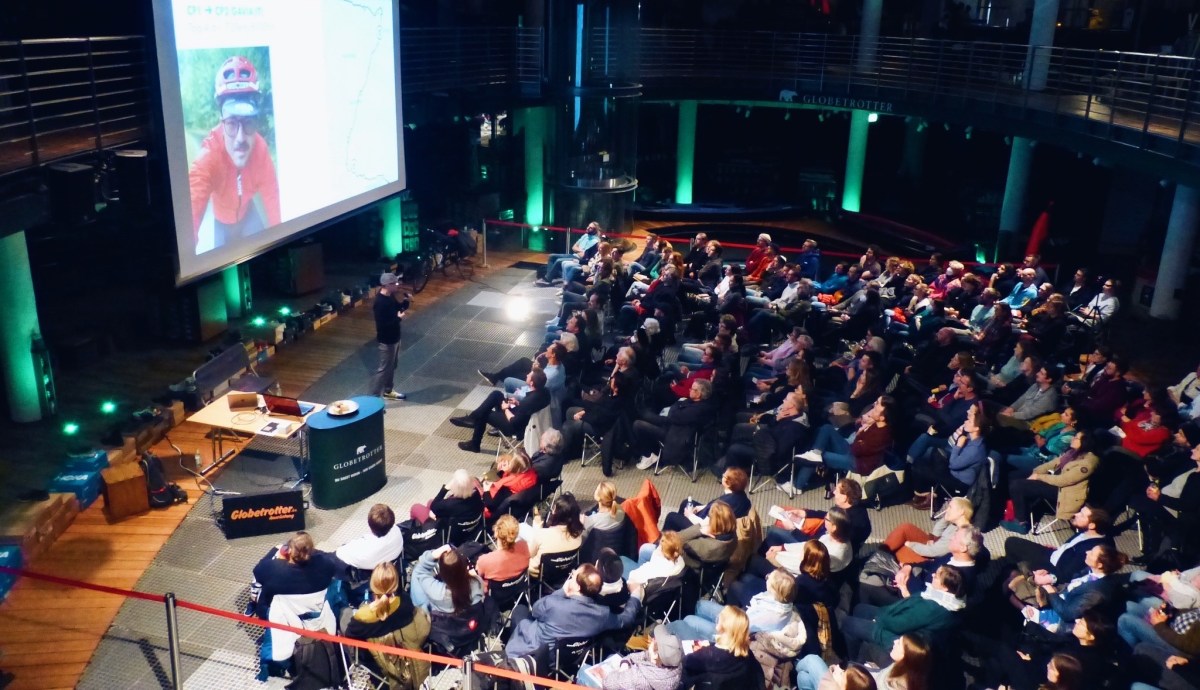
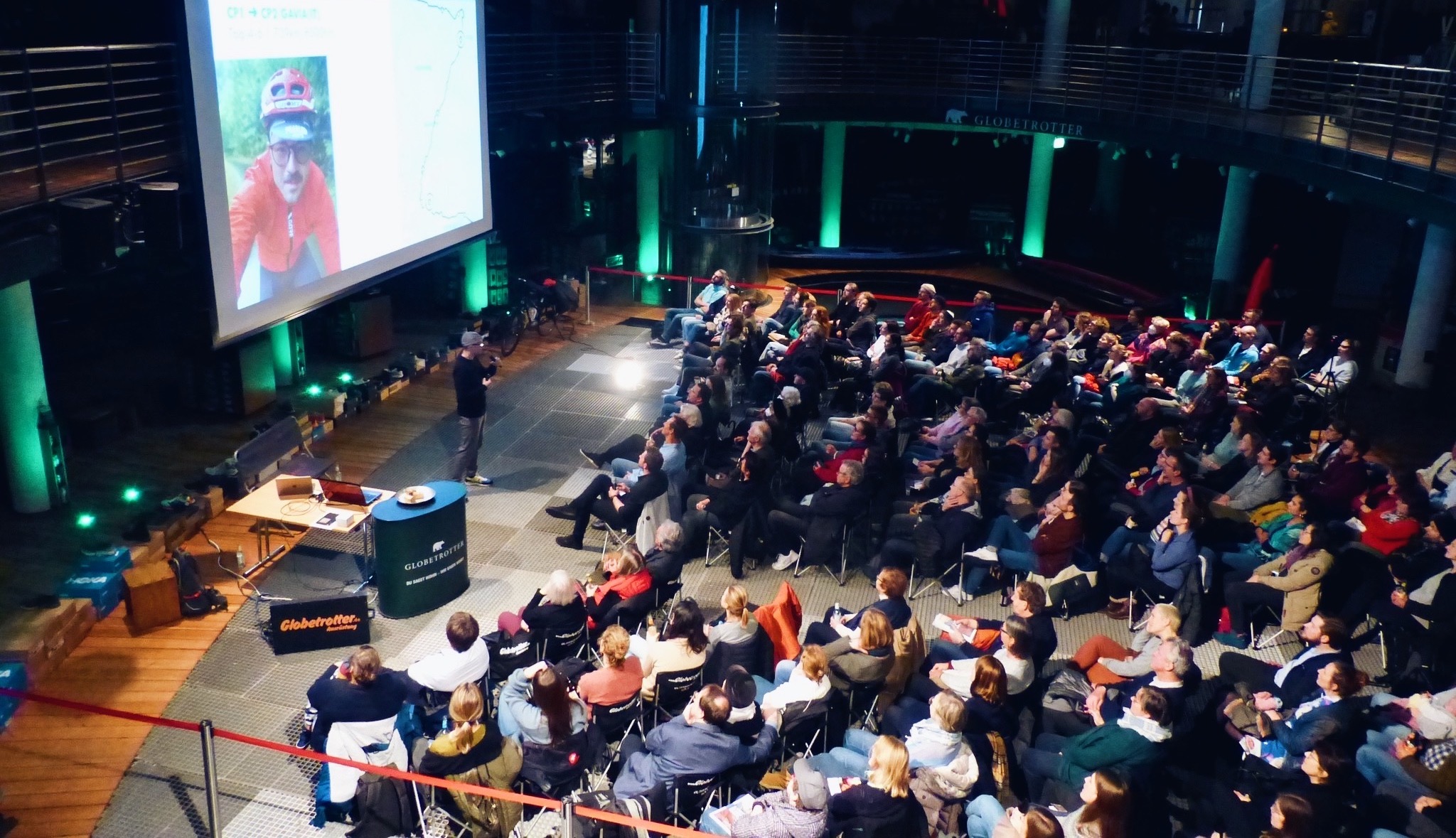
Ich hatte die Freude beim Travel Slam im Globetrotter in Köln über mein Transcontinental Race No. 8 (2022) zu sprechen.

Da ich das Publikums-Voting gewonnen habe (vielen Dank!!) durfte ich außerdem zusätzliche 5min+ über ein Thema meiner Wahl sprechen: ich habe mich für meine Gedanken zur Frage “WARUM?” entschieden und sie in 4 Kapitel eingeteilt: Großer Kontext, Kleiner Kontext, Unabhängigkeit, Verbundenheit.

Danke an de Travel Slam für die Einladung, das Publikum für’s Kommen, Interesse und Enthusiasmus, und an die beiden anderen Vortragenden Carsten Grüttner (@bikeload) und Wolfgang Hollmer für ihre inspirierenden Vorträge.

Neben ein paar Fotos findet ihr unten auch beide Videos, um meine Vorträge anzusehen (ggfs. ist es komfortabler sie durch klicken auf das YouTube-Symbol im Video direkt dort zu sehen)

Travel Slam – Hauptvortrag TCR No. 8

Travel Slam – BONUS-Vortrag “WARUM?”

UPCOMING: Köln, Do. 2.2.23 – Vortrag beim “Travel Slam” im Globetrotter (German)

[in German only]

Am
Do, 2. Februar 2023, 20:15h
bei Globetrotter Köln
Richmodstraße 10
Köln, 50667

findet ein sogenannter “Travel Slam” statt: 3 Vorträge von Reisenden. Am Ende wählt das Publikum den Favoriten und es gibt eine Bonus-Runde.

Ich werde 15 Minuten lang mit Bildern von meinem Transcontinental Race No. 8 (2022) erzählen. Alle drei Vorträge des Abends drehen sich um Radreisen. Bin schon gespannt auf die anderen beiden von Carsten Grüttner (Kanaren per Rad) und Wolfgang Hollmer (Ein Scheibchen Europa für Sharron). Ich bin gespannt und freu mich drauf!

Eintritt: 10€, auch Abendkasse (die gehen nicht an mich)
Weiter Infos und Anmeldung: hier www.travelslam.de

Malte Hager • Maltes Transcontinental Race | Köln, 02.02.2023

– 4200 km mit dem Reise-Rennrad durch Europa

Einen Kontinent durchqueren in 2 Wochen… 4200km und zigtausend Höhenmeter von Brüssel ans schwarze Meer; mit dem Fahrrad und ohne Hilfe von außen. Malte Hager wird von seinem abenteuerlichen Transcontinental Race berichten: Einem der renommiertesten Ultra-Langstreckenrennen der Welt, das er im Sommer 2022 absolvierte.

Mit minimalem Gepäck, eher stringenter Vorwärtsbewegung, glitzernden Alpenpässen, Osteuropäischer Bergwildnis, Mikro-Begegnungen, ungekanntem Schmerz, Hundejagden, menschlicher Verbundenheit, Rausch und Rührung: Bei dieser Ausnahmeerfahrung konnte Malte sehen wie die vielfältige Landschaft und Kultur Europas innerhalb kurzer Distanzen variiert und wie auch der eigene fluktuierende körperliche und mentale Zustand zu jedem Zeitpunkt wenig Gewissheit über den weiteren Verlauf des Radreiserennens gibt.

Malte wird erzählen wie er auf diesen Irrsinn kam, wie das Rennen verlief und sich anfühlte und was ein Baseballschläger und Lebkuchengebäck damit zu tun haben.

Homepage: www.cyclingtourist.com
Instagram: @maltecyclingtourist

TCR No. 8 – about *official* results, stats, penalties update & subjective conclusion

CONTENTS:
1. Official Results
__1.1 Leaderboard
__1.2 Rider status – stats & cases
__1.3 Distances ridden & FMC error
2 Penalty updates
__2.1 General penalty stats
__2.2 Update MNE-border penalty
__2.3 HS07 Austrian highway
3 Concluding remarks… (subjective)

First of all: Congratulations to all fellow riders!! No matter if you finished or not. It was a tough race and fantastic adventure. And also: Thanks to all dotwatchers, followers and friends of the race! Without you it would all just be half the fun.

With this one I want to provide an update to my previous post; now referring to the official results (as opposed to just preliminary) of this year’s Transcontinental Race No. 8. I think that previous post may be interesting to some nerds that haven’t read it yet. It goes into a lot of details, but I think they raise more general points and questions. But: I should also acknowledge what the official results and also penalty outcomes were – after all appeals, and some discussion that certainly took place. Hence this post: I will provide you with some updated stats, add some new little stats, report on how the penalties turned out, and will have a few concluding thoughts.

1. Official Results

The official results were published on 26th of October 2022 and you find them here. Everything that follows is obviously only my own compilation of and commentary on some information out of it.

1.1 Leaderboard

The top of the leaderboard of the ca. 4250km race incl. all penalties looks as follows:

SOLO overall:
1. #100 Christoph Strasser – 9D 15H 0M
2. #75 Adam Bialek – 9D 23H 22M
3. #160 Pawel Pulawski – 10D 2H 6M


SOLO Women:*
1. #1 Fiona Kolbinger – 10D 13H 44M
2. #14 Amrei Kühne – 11D 19H 48M
3. #48 Meaghan Hakkinen – 12D 11H 21M


*there are mixed views on whether to spell out the women’s podium or not (also among women). e.g. female-directed TCR itself does not spell it out. So, for those who like it, I do.

PAIRS overall:
1. #252 Theo Daniel & Stephane Ouaja – 12D 8H 50M
2. #251 Richard & Sam Gate – 13D 3H 16M
3. #256 Christopher Dunand & Jonathan McCarthy – 13D 9H 49M

Please check the official leaderboard to have a look at the other amazing riders at the top and throughout the list!

Congrats to everyone! Incredible what these riders achieved. Assuming the distances quoted further below, these top riders did as a daily average up to 450km + several thousand m of climbing.

I’d like to give an honourable mention to Ulrich Bartholomoes who was a top-contender against Christoph Strasser; he ended up in a very unfortunate situation at a ferry that turned out not to run. That situation was not exclusively on him (worth its own discussion), but was responsible for him not making the top 3. So:
4. #50 Ulrich Bartholomoes – 10D 3H 2M

Another rather extreme case was rider #233 Krystian Jakubek who arrived physically in second place. But due to massive penalties he was now placed on 6th position – among them the border crossing penalty and some of the rather “surprising” unique penalties I mentioned. (The case also stirred some discussion that I will not go into now. If interested, check the “unique penalties” section in my previous post)

In the pairs, the outcomes of penalties changed the second position so that it now goes to “the Gate Family” – congrats! They had considered the “illegal” border crossing into Montenegro (check my previous post where I handle this in detail), but decided against it, because they assumed it might be penalised. And they were right! So them ending on 2nd position was not a matter of luck, but a matter of deliberate strategic choices.

Just because it may be interesting to some, here’s also a table of the Top10 solo riders with a comparison between physical arrival ranking and post-penalty official ranking. It illustrates how big the impact of penalties can still be. I didn’t calculate it for the whole field, but just for illustration: I myself arrived physically as the 66th rider, and am now ranked on 61 – despite a 5:30h penalty. Really doesn’t matter or do anything to my sense of achievement, but shows that penalties have effects for the whole leaderboard.

1.2 Rider status – stats & cases

And here are just some general stats regarding the rider status:

SOLO-Riders:

  • 41% arrived within the time cutoff (16 days, i.e. General Classification)*
  • 12% Finished outside of the GC
  • 47% of starters scratched

To my knowledge, the scratch-rate is the highest of any TCR edition so far.

Two riders’ status were changed from “Finisher” back to “GC”*. Among them Jesko von Werthern who was originally suspected by the Race Direction to have stayed in private accommodation (which would mean: supported), but could explain and prove that this was not the case.

4 riders who originally arrived within the 16 days to achieve GC status, lay beyond the 16 days including their penalties; technically outside of the GC. This was particularly due to the border penalty (5,5h). The race direction decided to leave those riders within the GC. They justified this by acknowledging that the penalised border-crossing was deemed ok to use in edition 4, but not in this one, so there may have been confusion. I know that to some of those 4 riders this did matter, so I’m glad it turned out that way. Congrats!!

*”GC”/”General Classification” means that the rider arrived within the time cutoff AND followed all the most important rules & requirements, and is therefore awarded a ranked position. “Finisher”s are mostly riders that arrived at the finish line after the cutoff, but did ride all the distance through the Checkpoints

PAIR-Riders

  • 31% arrived within the General Classification
  • 19% Finished outside of the GC
  • exactly half of the pairs riders did not finish.

In one case one rider of a pair scratched, but the other continued the race, so he was awarded Finisher status: #251b Olivier Caty. Congrats! Obviously he could not be listed in the GC as his effort with a mix of supported and unsupported could not be compared to solo-riders’ rides.

The high DNF-rate overall is remarkable. And it is not entirely clear to me why it is so high. Some people – among them some of the most experienced TCR veterans – claimed this to have been the “toughest edition yet”. But obviously that is hard to define let alone verify. Every edition is unique; too many factors that make them incomparable.

Clearly, this edition was the longest yet in terms of distance, while the cutoff time of 16 days remained. So riders had the same limited time to arrive at a longer distance. Possibly that had a discouraging effect on a few riders who realized they wouldn’t make it in the time they previously envisioned.

1.3 Distances ridden & FMC error

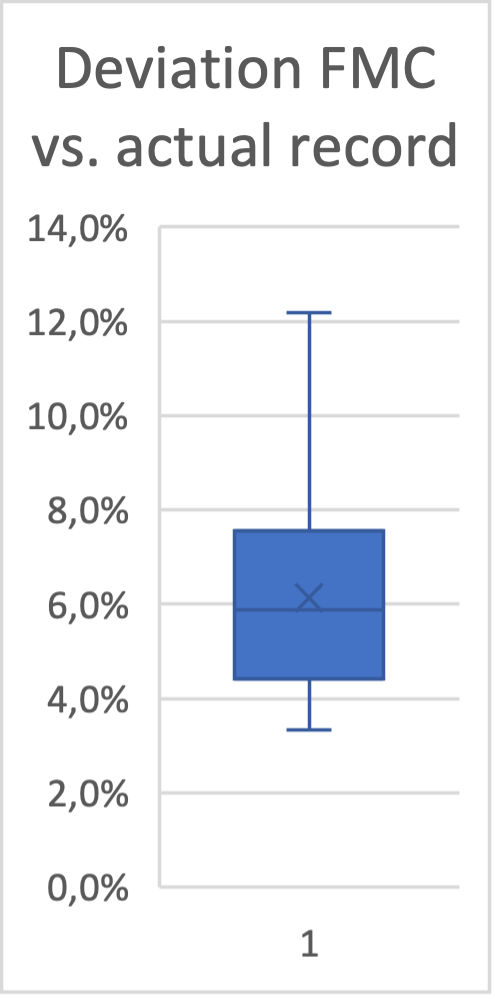
Speaking of it… related to the distance of this edition I have some more stats. Firstly, based on 13 riders only, for who I had the actual ridden total distance, I established that Followmychallenge overestimates riding distances by ca. 6% on average (but can be up to at least 12%). (I also checked: this deviation does not depend on the distance)

If you rode TCR No. 8 and know your total distance based on your own tracking (not FMC), feel free to drop me a line. It’s an interesting data point!

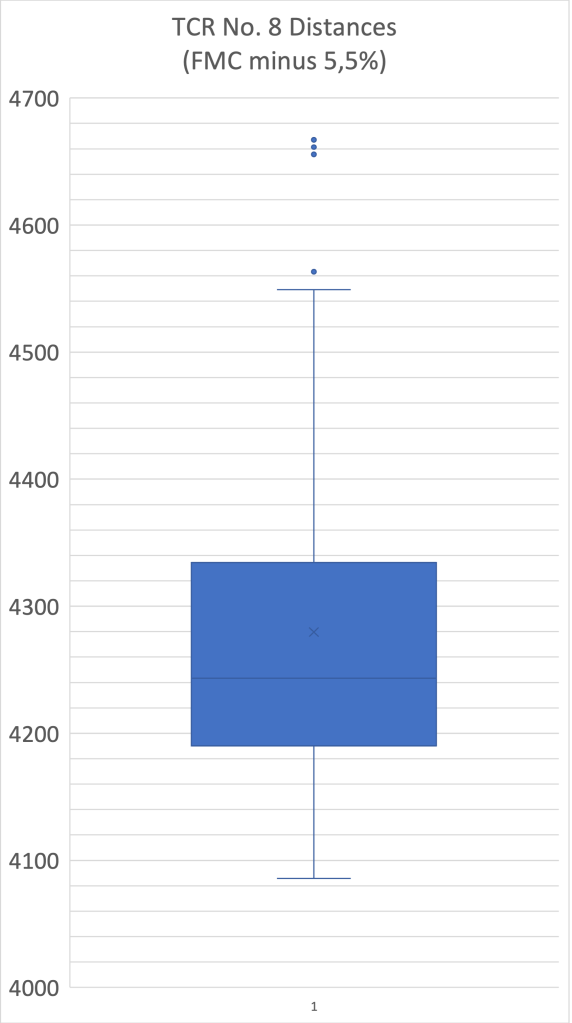
I applied that information to all total distances reported by Followmychallenge; i.e. substracted 5,5% from the FMC-distance to arrive at an estimate of the actually ridden distance. This will not be correct for each individual rider, but in total I assume deviations will be random and equal out.

On average Finishers rode around 4260km. More precisely, the mean distance was 4280km; while 50% of riders rode more and 50% rode less than 4240km (i.e. the median). The difference is due to some extreme positive outliers like Mikko Mäkipää who did 4591km (not because of bad planning; quite the opposite, as many will know). 50% of riders lay within 4190km and 4340km (i.e. the blue box).

2. Penalty updates

If you really want to read up on some “inside TCR” penalty insights, I recommend to check out my already often mentioned previous post on the preliminary results. There you find a detailed description and discussion of all things penalties.

2.1 General penalty stats

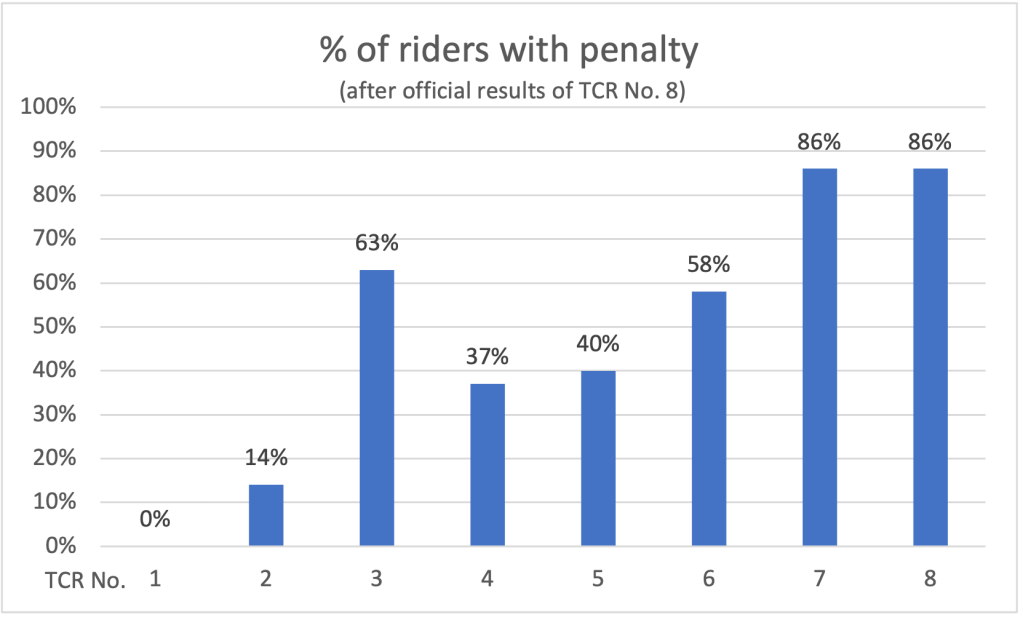
On average, solo riders received 4,5 hours of penalties. That accounts for the fact that the wide-spread border-crossing penalty was reduced (see below). Among those riders that received a penalty, it was on average 5,0 hours.

Independent from the reduction of the border-penalty, for 33 riders (37%), some penalties were lifted. That means that 33 riders successfully appealed. That is 45% of riders who got a penalty, which seems to be in line with the “guilty until proven innocent” policy that I discussed in my previous post. It is not known to me how many of the remaining 55% handed in an appeal that was rejected, how many did not hand in any appeal at all, and how many of those in turn would have been successful with an appeal. I do know a few cases where mid-pack riders decided not to appeal because it didn’t matter to them, even though they were sure not to have committed the infringement.

Now after appeals the number of riders without any penalty rose to 12 (previously 6). That means 86% of solo riders received a penalty. So the updated diagram on how this number developed over the years is as follows:

2.2 Update MNE-border penalty

Most remarkably: The border crossing penalty was reduced from 9:35h to 5:30h (i.e. 4 hours). As a reminder: 60% of riders received that penalty, which is why this penalty matters quite a bit, and as you may have read in my previous post, the penalty was also quite controversial. This means that effectively the sanction was turned from a penalty into a mere rough compensation of the time riders saved with that border crossing. Coincidentally that is a suggestion I proposed in my post; but I strongly doubt I had any impact on the decision.

How many riders actually crossed here legally? I did not check for each rider who originally received the penalty, if they now got a reduction in penalty (beyond the 4h they got anyway), but: Originally 52 riders got the border-penalty. Now in the official results there are still 53 riders with a total penalty above 5,5 hours; one of them was added (Jesko, see above). Given that it is highly unlikely for many riders to get beyond 5 hours of penalty without the border penalty, I assume that no rider (or at most very very few) provided evidence that they actually crossed legally. So, probably almost every rider who crossed that border did it without the technically required stamped paper. In my view that supports my theory that 60% of riders had a different expectation as to what actions were totally ok as opposed to the race direction’s view.

LostDot statement about the decision: Along with the email regarding the official results, riders also received this explanation as to why that penalty was applied:

“The ideal means of using an unmanned border would be to find a means of using it legally, and document that as per the instructions in the Race Manual. […] If we had prohibited the border in question it would have prevented the kind of considered planning we want to encourage on the Race. If we had provided instructions on how to cross the border it would have prevented those with the foresight to plan correctly from having the edge on their competitors. If we had not penalised that border those who made the decision to use the legal entry due to failing to get legal permission would have been very unfairly penalised. For an adventure Race that requires compliance with the law (as all races do) I feel the decision was fair and measured.”

This explanation is in line with the pro-penalty arguments I myself laid out in my previous post. As I said there, too: it is a matter of judgement. In this case it was a pro-penalty judgement, but with a reduction of the penalty, which I think makes the penalty less controversial. (But if anyone cares: I’m still not 100% convinced for quite a lot of reasons.)

2.3 HS07 – Austrian highway

As described in my previous post: This penalty was given to 50% of riders. Based on the sample of tracker details that I checked (followmychallenge & some Strava records) I could not find anyone who actually took that illegal stretch of the Austrian B180 and would confidently say: Except for at most 1-2 riders, no one took that road, so the penalty was entirely unjustified. If I am wrong: please let me know! I have not heard anything about it from LostDot (race organization).

I had previously suspected this penalty would be lifted altogether, as it must have been given in error. But I have reason to believe that this penalty was only removed where riders appealed. This is a bit hard to prove as the final results do not split out separate penalties, and I do not know which riders appealed and which did not. But I know one rider who received this penalty in error ((s)he did not commit the infringement), did not appeal, and still had the same total penalty in the final result. That gives reason to suspect that many other of the still standing penalties regarding this road are unjustified. So the race direction did not acknowledge their (supposed) error – despite certainly receiving many valid appeals against this penalty, where they had to correct it. They handed out an erroneous penalty to 50% of the field and stayed with it where no appeal was made. Remarkable. And unclear to me what conclusions to draw from that about the processes behind penalties.

Again, in case anyone knows more… please let me know.

3. Concluding remarks…

Ok, the following section is purely subjective:

I think to any rider who participated, this race edition was again a very exciting experience, and to many certainly had the quality of a lifetime milestone. Finishing or even just starting TCR is a big deal. Riders gave all their heart and body to the challenges thrown at them. Went again through probably some of the highest highs and lowest lows of their lives, within just 2 or so weeks or even just hours. In that way the notorious Transcontinental Race contributed so much again to so many people’s lives. All that was definitely the case for me.

At the same time the race may also go through a transformation. Race direction is changing: There’s a new team taking over that includes one in my view very experienced and accomplished rider and a charismatic and invested race director. I am so curious to see where they take that race! And regardless of whether I will ride a TCR again or not, I am thankful for them to not only keep that amazing race running, but also develop it further.

Further development of the race will require approaching and listening to riders. In my view there is a lot of potential to make the event more about riders and their experiences again; my impression was that in many ways there was a lot of focus on many other stakeholders, incl. the organization itself. Maybe rider-input (incl. the rider now on board of the team, yaay!) will realign some of the race-policies with the reality of riders on the road, and with the decisions and sacrifices riders make with their best intentions for 1,5-2 weeks straight. I think an empathetic way of addressing riders has incredible potential to make the social/community experience even more magical to everyone and emphasise “trust” as the most important element to keep everything within the spirit. That may also involve a re-orientation of the roles and tasks of volunteers and dotwatchers. I might issue another post on those ideas, but not sure (also not sure if anyone needs it hah. If you’re interested, follow me here or on Instagram; I will not post it on Facebook). And obviously if you have ideas, comments or wish to a chat with me and/or other riders, get in touch! (no matter what stakeholder group you belong to)

My previous post definitely triggered some public discussion. I received a lot of messages, heard many stories, some but not all of which I then added to the previous post. At the same time I really don’t want to overstate it; the private discussions were certainly more heated and extensive than the public ones, and I believe that also has to do with who has what incentives to be involved. I’d encourage every rider to not be shy thinking and talking about what makes a great ultra-race – not only related to TCR. There is still SO much potential in this young and growing sports discipline.

I’m excited about following the next TCR. And all the other beautiful races that exist. Maybe I’ll meet you at some point (again) at a starting line! Cheers!

20.10.2022 – Kölner Stadt-Anzeiger – TCR No. 8 – Video, Zeitungsartikel & Insta-Reel (German)

[material in German only]

20. Oktober 2022
Die lokale aber auflagenstarke Zeitung Kölner Stadt-Anzeiger hat über mich und meine Teilnahme beim Transcontinental Race No. 8 veröffentlicht:

//www.instagram.com/embed.js
Erschienen am 19. Oktober 2022 im Kölner Stadt-Anzeiger, Autorin: Larissa Rehbock

05.10.2022 – Gravel-Podcast – TCR No. 8 – Vorläufige Ergebnisse & Penalties (German)

[material in German only]

5. Oktober 2022
Pascal vom Gravel-Podcast hat mich eingeladen um über die vorläufigen Ergebnisse und Penalties (Strafen) des Transcontinental Race 08 zu sprechen.
Klicke hier oder unten.

15.09.2022 – WDR Lokalzeit (live TV) – TCR No. 8 Interview & Clip (German)

[material in German only]

20. September 2022
Das Kölner Team der WDR Lokalzeit hat mich für eine Kurz-Reportage zu Hause besucht und für ein Live-Interview ins Nachrichtenstudio eingeladen um über mein Transcontinental Race No. 8 zu sprechen.
Klicke hier oder unten.

02.09.2022 – Gravel-Podcast & Video Interview – TCR No. 8 vorher & nachher (German)

[material in German only]

2. September 2022
Pascal vom Gravel-Podcast hat mich und meinen Fahrrad- und Vereinsfreund Thomas Krechel eingeladen um über unsere Teilnahme am Transcontinental Race No. 8 zu sprechen. Und zwar vorher & nachher.
Klicke hier oder unten für das YouTube video. Das ganze Gespräch wurde auch als Podcast episode (nur Audio) veröffentlicht.

Und hier das gleiche als Audio-Podcast:

01.09.2022 – Kölnische Rundschau – TCR No. 8 – Artikel NACH dem Rennen (German)

[material in German only]

1. September 2022
Die Kölnische Rundschau (Autor: Moritz A. Rohlinger) hat einen weiteren Zeitungsartikel über Thomas Krechel, Jens Horstmann mich und unsere Teilnahme beim Transcontinental Race No. 8 veröffentlicht. NACH dem Rennen. Wir sind alle drei Kölner; Thomas und ich sind auch im gleichen Fahrrad-Verein.

Es gab auch VOR dem Rennen bereits einen Artikel in der Rundschau (hier klicken).

Erschienen am 01. September 2022 in der Kölnischen Rundschau, Autor: Moritz A. Rohlinger