TCR No. 8 – about *preliminary* Penalties/Results

[This post may be continuously updated with new data, facts or arguments supplied to me.]

CONTENTS:
Intro & Disclaimer
1. Some Results & Penalty Stats
__1.1 Rider Status
__1.2 Penalties
2. Zoom into specific penalties
__2.1 HS11 MNE border crossing – tradeoffs?

____2.1.1 PRO-HS11 penalty
____2.1.2 CON-HS11 penalty
____2.1.3 Other options…
__2.2 HS07 – B180 before Reschenpass
__2.3 Unique Penalties
____2.3.1 Discussion: “Riding on a road banned for cyclists”
____2.3.2 Discussion: “Solo riders riding together”
____2.3.3 Discussion: “Luggage drop to complete final parcours”
____2.3.4 Discussion: “Sharing a Coke” / “Cola-Gate”
____2.3.5 Why bother with those details?
“Conclusion”

FYI: I later also posted about the official results which you find here. BUT: The more important questions, interesting details and stories you will find here in this current post! It is not outdated.


Mid August the iconic Transcontinental Race No. 8 finished in Burgas, Bulgaria. In case you’re not familiar with it, you find some condensed information in this post of mine. End of September, LostDot (the race organization) revealed the preliminary leaderboard. Preliminary, because it contains penalties that can at this point still be contested by riders. I will possibly post a follow-up once official results are out. However… I think the preliminary results have some features that may get lost when only looking at the still to be communicated official results; what those elements are, I leave up to you (for now I want to refrain from issuing my opinions as much as possible).

Penalties in general are relevant of course because they decide over how closely the final leaderboard will match the “actual” physical arrival times and positioning of riders. Additionally, the whole topic is pretty much a black box to non-racers (actually also to some degree to racers!), as the documents were only sent to participants, and even the documents and race manual are not 100% transparent regarding some core features (as you will read later); so this is also an attempt to bring some understanding of the topic to a wider audience of enthusiasts, veterans, future riders, etc..

In this post I aim to summarise what these penalties contain – for which infringements they were given, and how much time each one presumably adds to riders’ physical finish times. In the second half I’ll zoom into some of the penalties; especially the Montenegro-border penalty and some specific banned road in Austria, as well as the “unique penalties” that I know about. If you have more arguments/ideas, please let me know in a comment or message!

To my German speaking readers… I was recently invited to speak on a podcast, where I talked about these things. If you like, click here:
https://gravel-podcast.de/episode/das-rennen-ist-noch-nicht-vorbei

Disclaimers

  • Everything I’m writing here refers to PRELIMINARY results. The final leaderboard and also number of penalties will (presumably) look quite differently
  • I really do not care about my own official time. I’m a mid-field rider; it really doesn’t matter if I’m position 60 or 70 (I do of course care about equal & fair application of penalty standards to all riders incl. myself)
  • In this post I’m referring only to SOLO riders (was easier to analyse) in the General Classification (which means esp.: those that finished within 16 days. only relevant there)
  • Resources are: mainly the preliminary results table provided to all riders by LostDot, other riders’ accounts; any speculation (or opinion/evaluation) will be clearly marked as such.

1. Some Results & Penalty Stats

Again: all this refers to SOLO riders only! And again: preliminary results. The implications for pair riders are similar though.

I really like the fact that LostDot provided such a clear overview over recorded times and given penalties. They sent an extensive data file to all riders that allowed them to see

  • when they physically arrived at each checkpoint
  • what their recorded finishing status is (GC, Finisher, DNF or Disqualified)
  • what their physically recorded finish arrival time was
  • how much penalty they each received in total
  • what (assumed) infringements the penalties refer to (except “Unique penalties” that were communicated in private emails)

So each rider could look up their name in the list, and see for which penalty type they were marked an “X”. That table allowed me to create some stats:

1.1 Rider Status

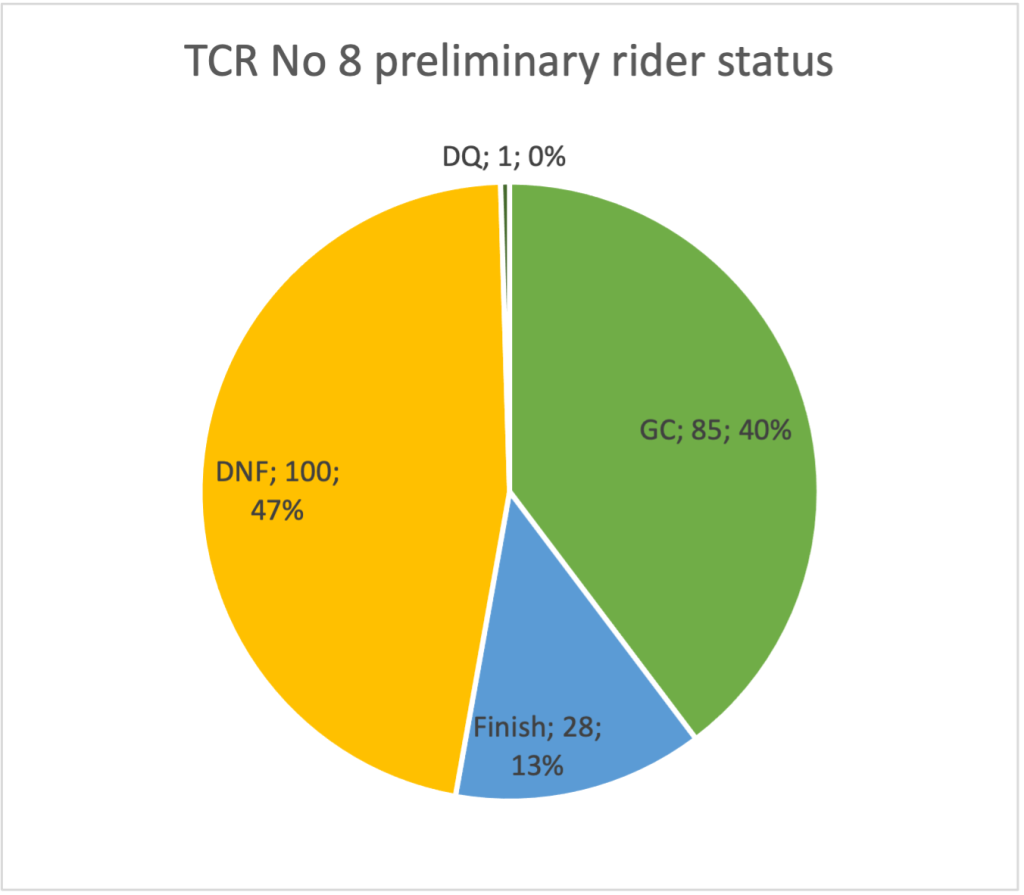
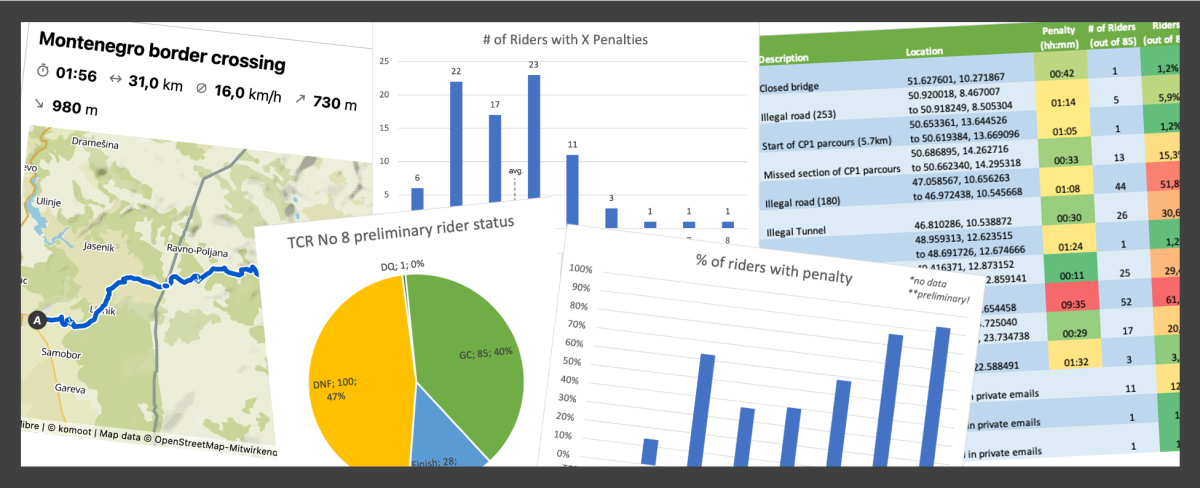
250 solo riders were originally accepted & registered, apparently 214 riders started.

  • 85 riders (40%) made the General Classification (i.e. passed all CPs & parcours and finished in time)
  • 28 riders (13%) finished beyond the 16-day-limit
  • 100 riders (47%) did not finish (DNF)
  • 1 rider was disqualified

1.2 Penalties

There were two types of penalties given:

  • HSxx: 11 different penalties for “standard” infringements that were committed by usually multiple riders and refer to mostly classic situations like forbidden roads/tunnels
  • UPxx: 3 different Unique penalties for non-standard infringements. Those were not specified in the lists provided, but communicated to each rider via mail.

For all HS-penalties the location of the infringement was provided. The exact time-penalty was not provided per infringement and also not against which rule exactly the infringement stood; in almost all cases it is very obvious though: violation of traffic rules.
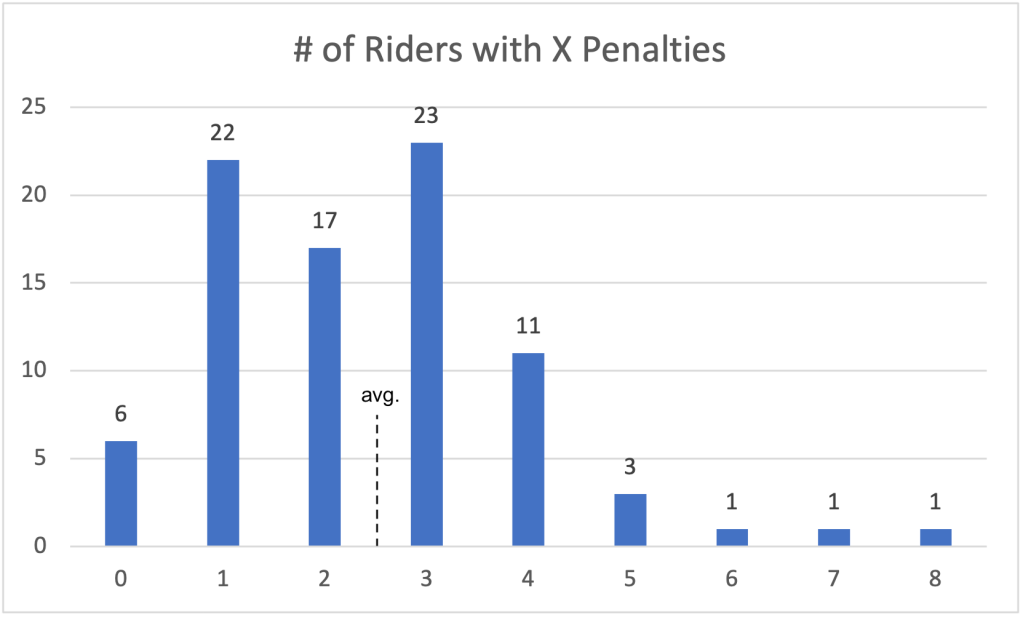
Y: number of riders who received penalties for X infringements
  • 6 (out of 85) riders received no penalty at all
  • i.e.: 93% of riders received at least 1 penalty
  • on average, each rider received penalties for 2,5 infringements

Just for context in comparison with previous TCRs: This preliminary percentage of riders who received penalties is higher than the final percentage on any previous TCRs. However, we don’t know how many penalties were removed from previous TCRs’ preliminary results after appeals.
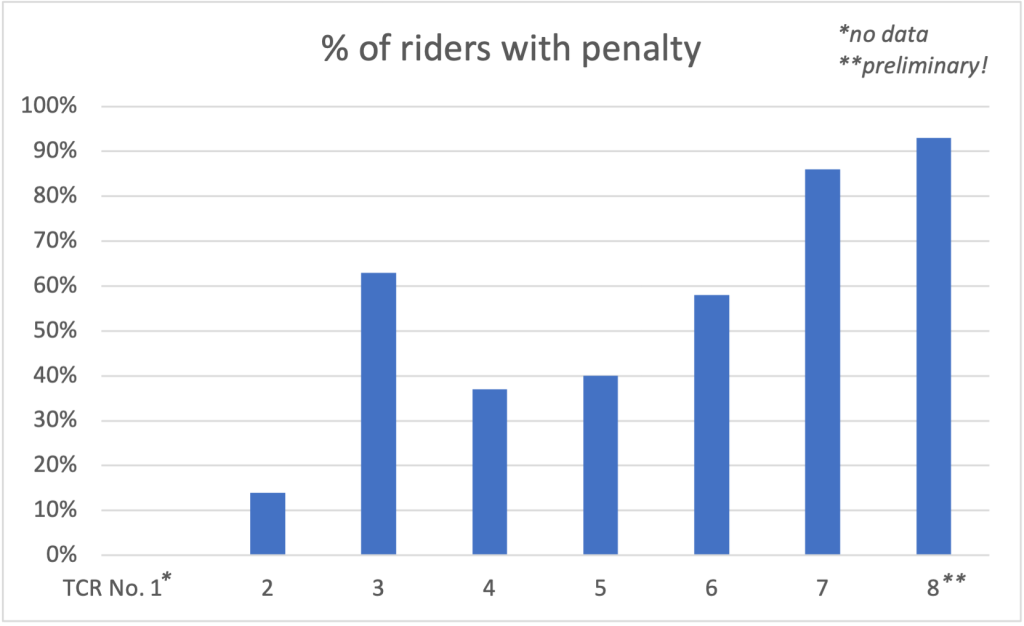
For each TCR: % of riders who received at least 1 penalty.

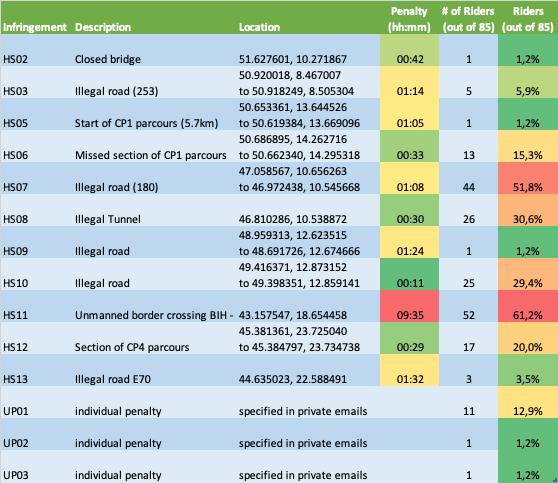
The specific penalised infringements were listed in the document, including a description and location. By checking individual riders’ total penalty time and what combination of infringements they were charged with, I tried to untangle how much penalty each individual infringement must have yielded (obviously, if I made a mistake: let me know!) – it may be that here and there “discounts” were applied when riders self-reported their infringements. In that way my calculation my be a bit distorted; but since we do not have any other detailed information, this is all I can report.

Just to quote LostDot (from the email that came with the file); that secrecy was deliberate: “Lost Dot will not share the time penalty awarded for each separate infraction or error so please do not ask.” I do know some rider/s requested more information about how much their unique penalties added, and the response emphasized that the above statement holds. But since I assume there was some consistency in how penalties for the same infringement were applied to multiple riders, I suppose my deductions should be fairly accurate.

I also added a column for the number & proportion of riders who received it and colour-coded those based on severity.

The document also stated that appeals for all penalties would be possible by means of providing a public Strava record, GPX-file, photographs or video-material as proof. Except for HS11 (border-crossing), for which only proof of legal entry into MNE is allowed (letter of permission, stamp, etc.). For unique penalties (UP) means were communicated to riders in individual emails along with the reason and penalty. For at least some UPs no appeal was allowed in the first place (stated so directly with the UP notification mail; see section 2.3 for more details).
Fellow rider Jean-Baptiste (Instagram: @jbtk42) compiled a map with all locations of the penalties; thank you!

Main features:

2. Zoom into specific penalties

Let’s have a closer look at a few specific penalties; I’ll partly leave the mere description here and go a bit more into a discussion (in the “unique penalties” part I will also go a bit into an evaluation).

2.1 HS11 MNE border crossing – tradeoffs?

This penalty is particularly interesting of course because a) so many riders (61%) were affected and b) it awards 9,5 penalty-hours and therefore is clearly most responsible for any deviation between physically recorded time and time “in the books”. There was no reason provided so far by LostDot (I asked) as to what arguments led them to their decision for enforcing this penalty in this way. I also do not want to speculate, instead just provide some arguments FOR and some AGAINST this penalty as well as ideas of what other ways of handling it there could (have) be(en). But first:

What is this penalty about anyway? This refers to a border crossing just before Checkpoint 3 (Pulzine, Montenegro) from Bosnia to Montenegro (MNE). For a lot of riders’ routes leading to MNE there were a few options to get from one of the last towns in Bosnia – Gacko – to the Checkpoint: Either 1) through an official border post further north or 2) another one further south; these two would have made the route to Pluzine about 95km from Gacko incl. some climbing (800-1000m). Option 3) an unmanned border post straight ahead over the mountain ridge, at an altitude about 500m higher than Gacko. From a pure cycling- and routing-perspective, the latter was a great option: shorter, more beautiful, less climbing, more adventurous, and also a little gem because it took some research to evaluate it and deliberate choice to use it.
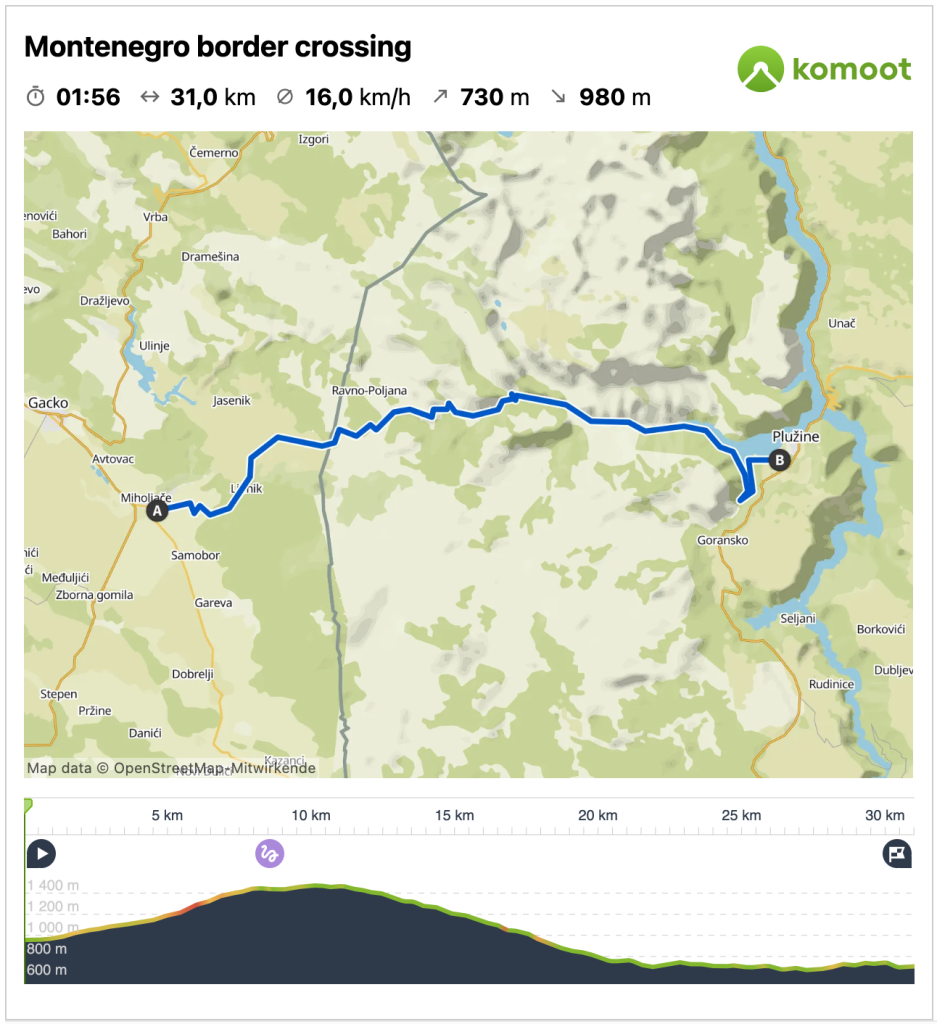
komoot route showing the shortcut via the unmanned border crossing from Gacko/Bosnia to Pluzine/Montenegro

Technically though, to cross there legally – in the middle of nowhere – riders needed to have a stamped document from local authorities that allowed them to cross. It can be assumed that almost no rider had this document, and instead crossed without it because as you might imagine it is logistically tricky and very time consuming to include a trip to the right local authorities in the short ride through Bosnia. It is also clear: with proper research all riders must/should have known about those regulations.

It was a bit of a gamble for all riders if they’d be able to cross, as there was a chance of being stopped by mobile border guards: Obviously after a few dozen riders crossing, local authorities may have picked up on it. To find out if you could cross, you first had to climb up ca. 500m. So there was a risk tradeoff regarding whether it would really save time. Some riders just got through without seeing anyone (see video below). Some (like a few riders the night before me) bumped into border guards and were required to use an official crossing (i.e. big detour), or (not sure) maybe even pay a fine – I’m sure there are more stories to be told. Additionally it was unclear what the surface up there would be: all sources that I know said it would be gravel on the MNE side; to many riders’ surprise it turned out everything was perfectly paved throughout.

Here’s a video of the border crossing:

In the following sections I’ll list a few arguments for and against that penalty, and it may look a bit excessive. There are a few reasons why I’d like to do it though:

  • all the options give some insights into the race and riders’ decision possibilities and processes. Maybe interesting to some future riders or particularly nerdy dotwatchers
  • it may help us appreciate the difficult decisions the race organization needs to make
  • I think it is worth thinking about whether these kinds of actions (like that border crossing) should be allowed in ultra cycling or not. These kinds of acts of civil disobedience may be in line with the free spirit of self-supported adventure cycling; but maybe not with a race format?

2.1.1 PRO-HS11 penalty

First a few arguments for applying the penalty:

  • as mentioned above: most crossings here will have been illegal because riders likely did not organize a stamp. If one assumes that any infringement of local laws is against race rules, it is a clear violation of race rules. In fact, the race manual says: “Any rider found to be breaking local laws may find themselves excluded from the race.” (see also the matching counter argument below) Above that, the rider agreement (signed by all riders) says: “6.1.10 [riders] shall observe and comply with […] all Relevant Laws and any other directions, codes of practice or guidelines imposed by national law or any competent authority applicable to the Event […]”.
  • understandably LostDot may not be keen on being associated with mass-infringements on border regulations. A penalty could be one way of discouraging riders from doing it, OR maybe more importantly: for LostDot to prove to any authority that they definitely did not encourage it; in case some conflict between LostDot and authorities would arise. In fact, the race manual states “Lost Dot reserves the right to exclude any racers for activity or behaviour that brings the race into disrepute or threatens the viability of any future editions.”
  • some riders may have anticipated a penalty if they would have taken that crossing illegally, and hence decided against it (I know at least one case). For those riders it may be considered unfair if no one received a penalty after all and they could easily have saved 4-5 hours.

If you have more pro-penalty-arguments, please let me know in a comment or message. Against these three stand a few arguments against giving a penalty here:

2.1.2 CON-HS11 Penalty

Now a few arguments against applying this penalty:

  • in TCR edition 4 this crossing was used by a few riders and there were no questions asked and no penalties given for it. Some riders who knew about that may have assumed it was tolerated by the race direction. According to one source, Mike Hall† (founder of the race) said about this specific crossing: “you roll the dice”, suggesting it’s up to riders if they take the gamble. Obviously I cannot confirm this, but if it were true, race policy changed over the course of the continuation of the race after its founder’s tragic passing.
  • it may be debated if it actually goes against any race rules. Rule #9 says “Riders must know and obey local traffic laws.” I suspect it is not an accident that the wording traffic laws was chosen. Do border crossings fall under “traffic law”? My interpretation is “no”; but if the race direction thought so, one may ask if all riders must have assumed so based on previous communication. Apart from rule #9 there is in fact the above mentioned race manual statement: “Any rider found to be breaking local laws may find themselves excluded from the race.” – which is the only place I could find that ANY illegal behaviour is against race rules (thanks to LostDot for pointing me to it!!). However: The statement is embedded in a paragraph that otherwise exclusively and explicitly talks about and lists examples of traffic violations, so to me it sounds more like a reference to those. Also the “Penalties” section of the race manual explains arguments that all revolve around rider safety and banned roads and then state: “The race organisers give penalties to riders for misdemeanours that were likely unintentional but contravened either local traffic law or race rules.”. If it was important that ANY illegal behaviour is against the race rules, it may be worth communicating it much more prominently (e.g. in an adapted Rule #9, removing „traffic“); then, however, it would affect more things, like: illegal wild camping (which would very much affect the race), under what conditions fixed gear bikes are allowed, and maybe other technically illegal things that are a normal part of the race.
  • On the location there were no signs or other indications of a crossing being legal only under certain circumstances or any specific group of people. In fact, there was not even any sign that a border was or would be crossed at all (see video above) and to my knowledge neither on the way to it. There was also no physical barrier at all. So on location it looks pretty much like completely open terrain. So, were it not for riders doing excessive research in advance of the race (as they are expected to), it’s hard to argue that generally it could be expected from hikers and cyclists in the area to know the modalities; so the illegality of the crossing in general may be a bit ambiguous?
  • it was an option to all riders equally, and the same risk/time-tradeoff for all riders. Apart from those who clearly assumed it would lead to a penalty (why did they?) chances were equal i.e. fair.
  • using such a crossing might be considered very much in line with the free and adventurous spirit of ultra-cycling. A bit of civil disobedience, celebrating the liberty of cycling and transcending human-made products of authorities: borders (opinion: while it’s a simple and a rather “soft” argument, I find this one very compelling)
  • if >60% of very competent riders used it, it indicates that this majority of riders thought it’s ok to use; in that case there would be a systematic difference between what riders consider within the spirit and rules as opposed to what the race direction thinks. In that case at the very least it would indicate that prior communication of the rules by the race direction wasn’t universally understood and one may ask if riders were to be blamed and penalised for such a rather systemic issue. (Let’s say: when facing the decision to penalise >60% of riders it may make sense to look for errors also on one’s own part)
  • Given how obvious the border crossing option was (as evidenced by the sheer number of riders who used it) and since it had been used on previous TCRs, one may assume that LostDot was aware of it before the race, too. Therefore riders may have expected LostDot would ban this crossing in the same way they banned specific roads and other border crossings, in case they deemed it against the rules. The fact that it was not banned beforehand may therefore have suggested to riders it was tolerated.
  • IF giving the penalties was affected by the fact that border guards showed up, but would not have been given otherwise, LostDot would make use of some hindsight-knowledge that riders at the point of making the decision did not have.

These above points are very directly linked to the crossing. Here are some more indirect arguments:

  • Race direction clearly tolerated (honestly, to me it felt like an invitation) the use of a very sketchy aqueduct in Romania. They featured it on several occasions, clearly stating it was for them technically ok to use. I did use that aqueduct, and while I do not know the exact legal circumstances around it, it is hard to imagine that witnessing police would have tolerated riders using it. It clearly only existed for workers – not regular pedestrians – involved a very narrow industrial sheet-metal bridge, a ca. 6-meter completely vertical iron ladder and situations of climbing that with a bike in one’s hands, handling it around some railings. On the other side of the river the situation was completely uncertain; in fact it was a pack of dogs waiting, high grass, a pitch black tunnel shared with train rails, etc. I very much appreciated the introduction of that aqueduct, and to me using it exemplified the spirit of adventurous ultra-cycling: making courageous decisions to push efficiency, exploring the unknown. Considering this sketchy place was totally ok for LostDot and I’d argue (based on how and how often it was introduced) “reverse-advertised” to be used, there was no reason to assume that a harmless and plausible border-crossing like the MNE one would pose a problem. These two decisions (aqueduct ok, MNE crossing not ok) seem a bit contradictory, embodying opposite ideas of what adventure ultra-racing means.
  • Much more generally one could argue whether the race direction should be concerned with minor legal infringements that neither severely endanger rider safety nor are unfair acts of one rider against another. But that is something to be considered not for this penalty alone, but maybe as a general thought for how penalties should be designed and how the race and the entire discipline might develop.

If you can think of more arguments for or against this penalty, let me know in a comment!

Thanks a lot to fellow rider Doug Hull for providing some valuable input on the arguments each way!

2.1.3 Other options…

I see two other ways in which this situation could (have) be(en) handled by the race direction (not saying yet that this is how it should be handled):

  • mid-race, when they noticed many riders use that crossing, they could have sent a reminder/announcement to all all riders that they consider it against the rules. That way everyone would have been aware. Such notifications were made use of for wild-fire warnings, a suspected error in parcours 1 gpx-file and a dangerous road in Croatia. (Side note: As has been debated, it could also have been used in Ulrich Bartholomoes’ ferry situation (for those who know. I won’t explain it here)). Downside would be that the first few riders who used the crossing would not have benefited from the announcement; but there sure would be ways to compensate this fairly.
  • Instead of a full penalty, they may opt to only award the time saved, which is ca. 4,5 hours (this is how much longer the detour through an official border post would have been). Of course then it would not have been a true penalty anymore, but merely a compensation to equalize times and make it fair to those who didn’t use the short cut in fear of a penalty. (Note: I suspect a penalty is something like the time saved multiplied by 2 or similar. Here 4:15min saved x 2 = ca. 9h35min.)

Maybe you see more alternatives?

2.2 HS07 – B180 before Reschenpass

This one’s a bit curious. It concerns a 13,4km-stretch of Austrian highway that is not open for cyclists. >50% of riders received this penalty (i.e. were accused of taking that highway), but: I checked a random sample of riders and based on their Strava records none of those actually rode that highway, and also the official Follow-My-Challenge (FMC) tracks do not indicate they did. The FMC heatmap shows almost no dots on that highway (thanks to Mikko Mäkipää for pointing this out), and even those may have been artefacts of GPS tracking. I find it a bit difficult to imagine what process may have lead the race direction to believe that half of the field committed this infringement, given it should be derived from evidence. It is also unclear to me in what way was distinguished between riders who received the penalty and those that didn’t, as their tracks seem not to look any different.

The race manual says: “Violations will be taken on a case by case basis.” – it does not look like this was applied here.

Either way – if the issuing of this penalty was an error or if it was based on some insight that I do not have right now – it will be interesting to find out how the penalty came to be. My personal guess is that the penalty will be lifted for all riders (incl. myself) except for at most a very small number who may have actually used that road.

Penalties HS08 (Tunnel Reschenpass) and HS10 (Czech road) that concern each 30% of riders have similar features: the FMC-track is in principle not accurate enough to indicate that riders actually committed these infringements, and in a few cases I checked, the penalty seems to have been given erroneously. BUT: for those two my research isn’t representative; and also while the FMC tracks do not provide evidence for it, they also do not show as clearly when riders did not do it.

Generally these cases raise my suspicion that generally riders who cycled through those areas were given the penalty regardless of evidence positively pointing to them actually committing these specific infringements; that in turn riders are expected to prove they did not do it. In fact the email sent along with the preliminary results stated: “In the presence of doubt Rules compliance [ed.: the 10 basic race rules] is generally assumed, qualification must be proved. This to me sounds like a “guilty until proven innocent”-policy which would explain to some extent the penalties mentioned in this section.

2.3 Unique penalties

As the name suggests, these were given uniquely to some riders. I do know though that a) some “HSxx”-penalties were also committed by one rider only (see above), while at least one “UPxx” was committed by more than one rider. So I can’t tell based on what exactly the distinction was made.

By getting in touch with some riders I found the following reasons for preliminary “unique penalties”:

  • “CP1, no HiViz vest” – no appeal allowed
  • “CP4, rode into the lobby” – no appeal allowed
  • “Parcours 4, riding without hands for extended periods” (that was the gravel parcours) – no appeal allowed
    (These first 3 together: 5:00h)
  • roughly: giving a Coke to a fellow rider (1:00h)/ accepting a Coke from a fellow rider (00:49h)
  • missed final section of parcours 2
  • Riding on a road banned for cyclists (and coordinates mentioned) (1:44h)
  • “solo riders riding together” (and coordinates mentioned) (1:45h) – no appeal allowed
  • “Luggage drop to complete final parcours to Burgas” (removal from GC!) – no appeal allowed

There are more that I did not find out about yet. If I do, I will update this list.

I did see some of the wording from the individual mails to riders. In those cases there was no elaboration on why there’s a penalty for the point; where I quote above, that’s all the information there was. That’s why I cannot provide definite insights into the reasoning; instead just look at the penalties themselves (also provided above where they are known); maybe – where possible – compare with what actually happened on the road, and go from there. And as already stated above – there was deliberately no time-penalty per infringement mentioned in individual mails (also not on request), but at most the total penalty (that also contains the regular “HSxx” penalties). In at least some cases (see above) the option for appeal was excluded rightaway with a wording like: “Accepted evidence: No appeal accepted. Incidents confirmed by Race Director. No appeal possible.”

While leaving most of these UPs uncommented for now, I want to address a few of them as they indicate again what the underlying principle/policy may be and may reveal other characteristics of the race direction’s appraoch . Now, there will be a considerable element of EVALUATION and some OPINION ahead.

2.3.1 Discussion: “Riding on a road banned for cyclists”

Riding on a road banned for cyclists (1:44h): In that case the rider realized on the location that the road was banned and took the next exit after 3,5km and self-reported her/his infringement. Also: the regular followmychallenge-race-track shows clearly that (s)he only rode on that road for those 3,5km. All that is exactly in-line with the recommendations by LostDot how to act, as to both the verbal, official rider briefing at the start and the race manual document; and above that I’d say it’s simply great sportsmanship. The result was that the rider received a penalty of 1h44min referring to an entire stretch of 24km until the next city. This is astonishing because: Without the self-reporting probably no one would have known about this infringement, which also means that someone must have seen the self-reporting, and despite it either decided or made an error to apply it to the entire highway stretch.

The race manual says: “Riders who act quickly, contact the race administration and promptly correct their route will find their infringement looked on more favourably than another rider who either remained oblivious or otherwise failed to amend their error.” – so the opposite happened here.

Apparently it is also not practice to have a quick look at what the actual tracker says (as suggested by this penalty and some of the regular penalties). Which again points at a “guilty until proven innocent” policy, but here even maybe “just in case” expanding the accusation and relying on the rider to appeal if they’re not happy with it. I fail to imagine the reasoning behind this procedure.
Additionally: Appeal for this one was allowed. “Accepted evidence: Evidence that the B239 is a legal road. Our evidence is that it is not legal for cyclists.” But actually “our evidence” can almost only be the statements of the rider her-/himself in their self-reporting. That would mean that they did make use of all the “incriminating” evidence provided by the rider her-/himself against themself, but disregarded the elements from the same self-report that would have been in favour of the rider. This suggests that not self-reporting would have been the much better and also fairer option for the rider affected.
The rider decided not to appeal as (s)he is ‘only’ in the mid-field, so it technically does not matter. It is hard to tell how many other riders do not appeal and in how many unjustified penalties that results.

2.3.2 Discussion: “Solo Riders Riding Together”

“solo riders riding together”: I suspect the accusation here is that riders somehow gained an advantage by riding together. What could such an advantage be?
A) Drafting? Since drafting is a very deliberate act, that would be so blatantly against the rules, it could – I suspect – even lead to disqualification.
B) Mental support or common decision making?
Regarding the latter: Riders meeting on the road is very normal and an important part of the race experience, as I also described in this blog-post. Also, riding alongside (as opposed to drafting) for a little bit should not be a problem, and I believe I’ve heard this verbalised as an example also from the race direction. So, turning such an encounter into an infringement would require some very confident judgement and also evidence. It is not entirely clear to me how that evidence may look; e.g. if the trackers provide enough detail.

FYI: Based on the affected rider’s account, the riders did indeed ride together, next to each other for a while, and chatted a bit. Of course there’s no way to validate this and I also cannot make any statements on of what nature exactly that encounter was.

EDIT 1)
I found another case… Josh Reid, the youngest rider of this edition, got removed from the general classification altogether for “riding with another rider for a substantial amount of time”. So he got listed as a finisher, but not GC. I do not know what evidence was used. Besides the tracker records the race direction may have referred to his YouTube videos where he also documented the episode in question. He addresses his removal from GC it here:

Josh’s penalty email said: “Penalty decision: Outside of GC” and then “Riding out of category (solo), riding together for significant period” and then two dates and respective geo-coordinates mentioned (one coordinate each only, i.e. not a stretch, but a point per incident). “No appeal accepted. Evidence proves riding together”. Interestingly, Josh asked Anna what “substantial periods are”, and the response was:

“Anything over a short chat (no more than 30 / 40 mins) is considered significant.”
(Please read my edit 2 below)

That is the first time I have ever heard this indication. That is clearly not from any of the provided manuals, but the Race Direction’s interpretation; which I think is fine in principle, the rules need to be interpreted. In any case it is interesting to hear that statement as it gives a bit more insight into the decision making than the otherwise very sparse unique penalty emails.
Above that I have no information on that case or what the riding together consisted of.

EDIT 2, 07.11.2022)
Many people seem to have found the 30/40-min very unrealistic (i.e. thought 40 min should be totally ok) and therefore deemed these “riding together”-penalties an unfair judgement. At the same time I gathered more detail on these cases that should alleviate these worries:
___a) Firstly, I learned that the tracking detail actually allows conclusions about riding together: To check this, I looked at cases of myself where I thought “this must look like riding together” (because of riding in very close proximity and leapfrogging for a period longer than I think riding together would be acceptable) and saw: on replay it is actually very clear that I did not ride together. I then compared it with the cases mentioned here, and the patterns look very different and coordination is obvious.
___b) Based on that it is very obvious in replay that Josh actually rode together with another rider for 13 hours. In very close coordination and ending in the same accommodation where they slept for several additional hours, but left independently. Josh’s own YouTube videos (here and here) confirm this riding together, too. So, importantly: It is NOT the case that he got removed from GC for riding together for just more than 40min. I am not doubting Josh’s integrity at all, and especially not his achievement! It was an incredibly strong and fast ride, just WOW! But 13h of riding together is definitely something race direction could not dismiss. Leaving him within GC would probably send signals to future riders. I think he could have been more aware of that when it occurred. Completely independent from this incident I highly recommend you check his videos about the TCR, but also e.g. his China->UK trip. They are so well done!
___c) In the other case, the riders rode together and also took rests together for 3,5 hours, as visible on the tracking replay. Certainly a degree of coordination. It happened in the mid-field. While I’m not sure this would really have needed sanctioning, I think it is legitimate. And with 1:45h penalty it is not overly dramatic, and what this also shows is that the race direction made a measured distinction between short coordination in the mid-field vs. half a day at the front-field.
___d) The statement quoting 30-40min was only made to the rider individually when he requested how “extended periods” would be defined. I suspect: The race direction just wanted to give him some answer, and based on the measured distinction between cases I hope that also in the future this will be evaluated on a case-by-case basis so that “40 min” does not constitute a fixed boundary. And: I even think 40 minutes is actually quite a while, depending on what happens in that time. Especially when riders are advised to avoid suspicion.

2.3.3 Discussion: “Luggage drop to complete final parcours”

[I added this one based on the comment thread below this post]

This one needs a bit of explanation, but it will be necessary for you to understand and evaluate the (I think remarkable!) penalty decision made:

Dropping off bags: Yes, dropping bags for certain stretches of the route is not within the idea of how TCR should be raced. You find the rule in the last sentence here. It is a bit hidden, which may be why not every rider is aware of that rule. For example: When there’s a climb to be done where a rider rides up and back down to continue the trip, they’re not supposed to drop their luggage at the bottom, but instead take all their gear with them. There was a case of one rider at least at Parcours 1 in this edition who did the first stretch without luggage, and then decided to do it once more with luggage so as to comply with the requirements (and because her/his conscience made him/her do it). One could debate whether such a rule is necessary, but that’s not the point now.

The rider in question… had arrived at the finish line on day 15 in the afternoon, half a day before the 16-day cutoff that made him eligible for being part of the General Classification (GC, as opposed to “only” a Finisher). Sadly, for some reason the rider missed part of the final Parcours that lead to the finish line. Obviously, without riding the parcours, a rider cannot be in the GC, and maybe not even be listed as a finisher (I’m not sure). Now imagine: battling for 15 days on the road, an incredibly tough last stretch with plenty of problems that lead to the late arrival and mis-navigation in the first place, heat, exhaustion behind you, arriving at the finish line, in safety, surrounded by great people and comfort. You made it! Almost. Then you hear you didn’t really do it, unless you now get up again, do another ca. 95km loop just to catch those 16km of the Parcours. A tragic situation, as anyone knows who has a shred of empathy with what riders go through.

The amazing thing is: the rider did do it. He got up again, rode the big lap, collected the parcours and arrived within ca. 30 minutes of the 16-day cutoff = GC. It was an incredible show for any dotwatcher and all riders witnessing (or even just hearing about) it. Those are the Transcontinental moments! Pain, decision making, sportsmanship, overcoming mental barriers, getting your ass up! That’s what TCR is about.

You saw it coming: For that final lap he left his luggage at the finish line and rode the 95km (and 16km that mattered) with a lighter bike than for the rest of his 4200km-trip. The race direction decided to give him a penalty for that. Not just a time penalty (like they did for riding without hands, or supporting each other with one festive can of coke). In that case he might have gone beyond 16 days, but if things are handled like in previous editions and hopefully with 5 other affected riders in this edition, he would have still been part of the GC he fought for so dramatically. Instead race direction decided to remove him from the GC altogether. This… in terms of his formal result rendered his last effort meaningless. He did that extra effort just to be part of the GC, and he got kicked out of it.

On top of that: “No appeal accepted. Photographic evidence proves luggage drop.” No one at the finish line when he left for the extra lap or arrived back 30min before the cutoff noticed that he had dropped his luggage. It was only discovered later on photos of his arrival.

What kind of behaviour, what character of the race is supposed to be incentivised and reinforced with such a decision? Above all for an end-of-the pack rider. Where is the confident judgement beyond paragraphs that helps really ensuring the spirit of ultra-racing as exemplified by that rider’s effort?

I think the rider will know that – while the race direction decided not to honour his race attitude at all (punish it instead) – he had all the respect from all people who know what it actually feels like on the road.

2.3.4 Discussion: “Sharing a Coke” / “Cola-Gate”

This case is quite famous. The two top-contestants Ulrich Bartholomoes and Christoph Strasser (who ultimately won the race) shared a can of coke. Each received 1:00h penalty for the incident. But probably things become more interesting with a little more detail and background story:

What happened? Imagine two of the very strongest riders of the field battling out an incredible race at the top (together with several other strong riders). On average ca. 450km + thousands of m of climbing each day. Unimaginable performance and sacrifice, physically and mentally, 100% determination. After 3500km of racing they encounter each other for the first time on the road, shortly before CP4 at the foot of the Transalpina climb in Novaci/Rumania. They decide to celebrate this encounter by having a can of Coke each. Ulrich’s credit card didn’t work in that shop, so Christoph bought the can for him. They drank their Coke, a few minutes, then each moved on. Christoph shared that outstanding moment on his social media. That’s the story.

Let me anticipate my interpretation of this situation: a fantastic display of sportsmanship. An emphasis of what this race is about: great community and comradeship “despite” incredibly sacrificial competition. It shows that the competition is about the sport and personal chievement, not about the other person, and that riders’ empathetic connection through their shared extreme experiences is much stronger than any rivalry could be.

There was just one problem: technically buying a drink for another rider stands against the most fundamental principle of the race: that riders are self-supported only, and do not share any resources. We do not need to debate whether that rule was broken or not. It was. BUT: it is worth discussing if that is relevant in the context.

When Christoph Strasser arrived at the finish-line as the first rider, the announcement of his victory was delayed by 1 day. The race direction first wanted to establish some clarity on the Cola situation. They waited for the arrival of Ulrich to figure things out. Technically that indicates that one consideration of the Direction was to not declare Christoph the winner; maybe even disqualify him (possibly Ulrich, too), although I do not have insights on that. Ultimately the Race Direction decided to declare Christoph the winner, and give both riders 1 hour penalty.

To arrive at that conclusion they had hourlong conversations with both riders about the issue. Ulrich had to provide evidence in the form of credit-card transcripts that proved that he had shortly before the incident fueled up on food/drinks and hence was not dependent on that can of Coke. That fact – him not being dependent on that Coke, and the Coke not changing the outcome of the race – apparently was responsible for the Race Direction to mostly drop the charges and not question Christoph’s victory.

I would like to present a subjective evaluation/opinion on that incident:

Firstly, I think it is good that the Race Direction noticed and also called out that rule breach. They did not make much public fuzz about it; but of course the mere fact that the announcement of the victory was postponed, led to a lot of public discussion. The reflex that I read/heard the most was “All that because of a can of Coke!?” – my initial impuls was admittedly a bit different, I thought: Yes, it’s a minor thing, but it is important to at least acknowledge that it is technically against the rules. It would have sent out potentially harmful messages if the Race Direction had simply let it slip without a comment; it may have indicated to some that the self-supported rule is open to personal interpretation and flexibility. I especially saw it as a very effective way to make everyone aware again that those basic rules of self-support matter; especially in the light of many new riders and races entering this young sport and the fact that I witnessed a very loose relationship with rules in other places than TCR. So: Of course I did not think the Coke should have consequences; but I did think acknowledging it was valuable. In some sense: An educational element.

The fact that i) the conversation between the race direction and the two riders took hours, ii) that the statement was postponed by a day, iii) that there were still 1:00h-penalties given, and that iv) the technicality of Ulrich’s transcripts saved the situation… all that looks like the Race Direction did not see it just as that educational and representative element, but viewed it very literally as a legal matter that needs consequences “by definition”. Not so much some confident “close-to-the-road” confident judgement that it wasn’t really that big of a deal.

Ultimately the general outcome was the “right” one – I think most people agree. I still think this case is interesting because in the light of also many other decisions I described so far, it seems symptomatic: These human judgements of situations – as opposed to merely “legally” based and automatic evaluations – would require great confidence and trust derived from a very solid and tangible understanding of the riders’ experiences on the road; otherwise nuances cannot be understood: of what it means to share a fizzy drink, go back on the road after finishing a 4200km trip, or go through the horrors of 3,5km highway cycling and then finding a safe exit. My impression is that instead of that kind of judgement, the organizers often gave in to the illusion of establishing perfect equality through “resetting” the things that actually (or allegedly) happened on the road by means of methods that feel watertight – a preference for following self-made paragraphs that results in a massive amount of penalties and here and there decisions that do not exactly do the spirit of riders or ultra-cycling a great favour.

And with that we transitioned from Cola-Gate and other specific cases to more general thoughts on how penalties were given and why it matters:

2.3.5 Why bother with those details?

As you may notice, I got more and more opinionated throughout the past paragraphs. That is because after my first publishing of this post, I received a lot of messages and had a lot of conversations with other riders that uncovered the unique penalty stories I laid out here, and they increasingly left me in disbelief. The stats I presented a few chapters back were merely descriptive, and themselves allowed for a good amount of interpretation and I think indicate already some issues with how penalties are handled. But those unique penalties really give life to the decision making processes, because they show the actual fate of individual riders.

Why bother with those details?
All the previous explanations may sound like I’m being very picky, but: Firstly, LostDot themselves seem to be very picky about following rules and sanctioning very specific (alleged) behaviours. So it should be okay to apply the same scrutiny in the other direction. Secondly, and in my view more importantly: I think there needs to be a high level of trust between riders and the organization and the processes. Trust that decisions are made to ensure severe violations of spirit or rules are followed up, while there is also care taken to not excessively and preemptively penalise an entire field. That trust – both ways – is the most important currency in a sport discipline that claims to rely on community spirit and very few and simple rules. The two examples I picked here are maybe not doing that trust a favour.

Trust – both ways – is the most important currency in a sport discipline that claims to rely on community spirit and very few and simple rules.

Penalties within the context of the rider experience…
Above that, imagine through how much suffering and effort and how many crucial decision making processes riders go throughout a race. Every hour is filled with riders contemplating and making tradeoffs, reflecting their current and potential actions, while being emotionally on their highest high or lowest low, and are in physical pain… riders give A LOT into the race, for 9-20 days non-stop. In that light, I think penalties like at least the above examples (incl. the HS07/B180 penalty) should not be given lightly. While LostDot repeatedly claims that penalties would not be a commentary on riders’ integrity… they actually are; they contain claims about what a rider factually did or did not do (like: Did or did not ride 24km on a highway. Did or did not gain advantage by riding together).

LostDot repeatedly claims that penalties would not be a commentary on riders’ integrity… they actually are; they contain claims about what a rider factually did or did not do.

If it then turns out that processes leading to riders penalties are designed in a way for these judgements to happen, the dedication to fairness seems a bit skewed, i.e.: who expects riders to make a big mental and physical effort to be acting in a fair and well-spirited way, should also hold that high standard against their own processes. In my view that also requires a benevolent stance that includes assuming the best possible intentions in riders as opposed to assuming the worst. I’m aware this goes somewhat against a policy like “qualification must be proved” and the implied “guilty until proven innocent”; but maybe that is exactly a problem.

Who expects riders to make a big mental and physical effort to be acting in a fair and well-spirited way, should also hold that high standard against their own processes. In my view that also requires a benevolent stance that includes assuming the best possible intentions in riders.

“Conclusion”

I tried to present a mixture of facts, as “cold” as possible arguments and to clearly mark where I am expressing speculation, evaluation or even opinion (like in the previous section). As you can see, a lot of things are still open or unclear. I suspect we can be curious to hear some explanations once the official results are out that include the results from the appeals process.

Especially interesting to find out will be:

  • what was the reasoning for the MNE-border penalty
  • what reasoning (or error?) led to 50% receiving the HS07 penalty
  • how exactly the penalties are being computed. numbers like “00:11h” or “01:42h” suggest a very precise and clear method and that is also unprecedented in TCR. I am not arguing it would need such precision but apparently there is some kind of underlying method.

I have asked LostDot for a comment, but of course they are incredibly busy these days, which I really don’t hold against them. Clarification will probably follow. I am curious how the official leaderboard will look. I will possibly write a summary on that, too.

Above all I hope that all riders will be content with the way penalties were awarded, and that the outcomes are in line with the spirit of ultra-racing as it is understood both by both LostDot and by riders.
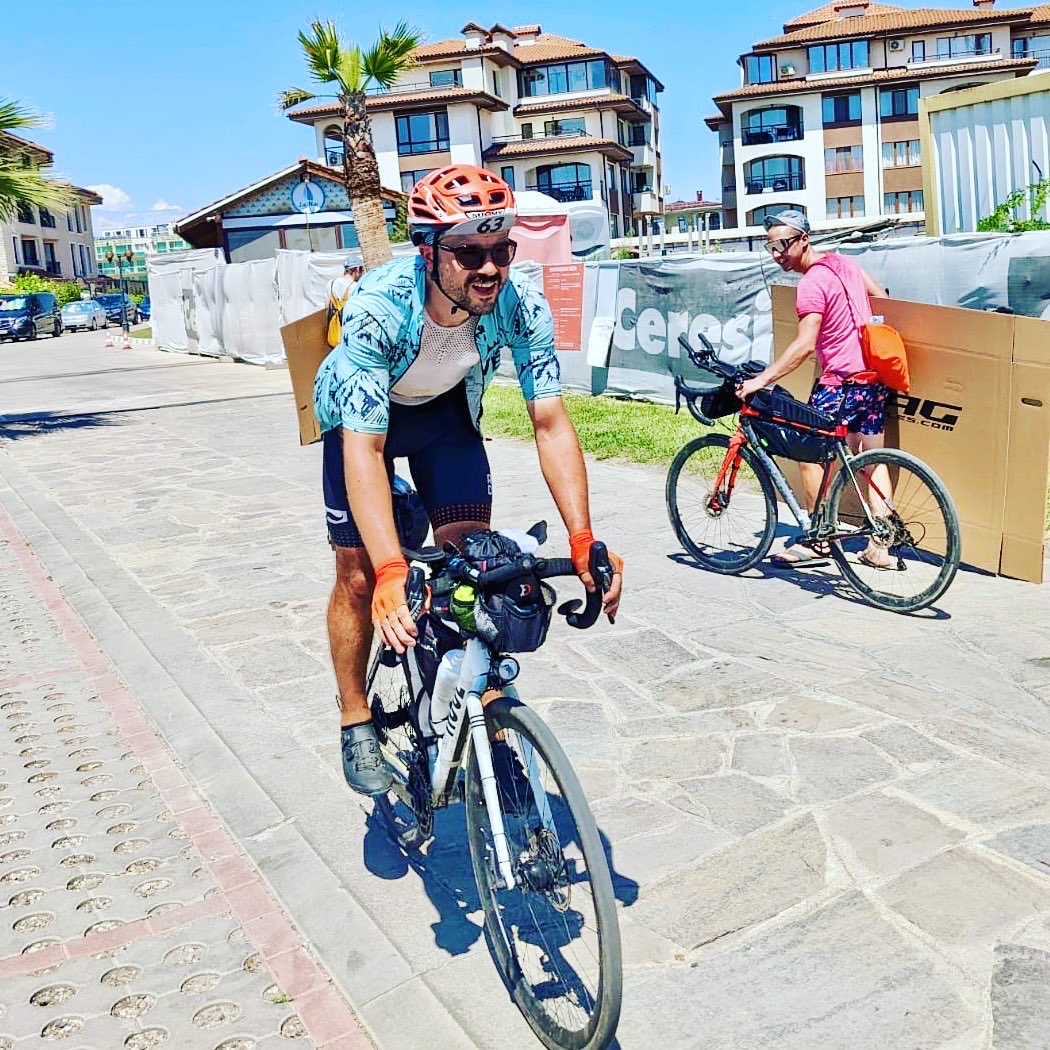
04 TCRNo8 – Finished! (on Mon. 8.8.22)

You’re now at post 04 of my TCRNo8-series. To jump to all so far existing posts on this in chronological order:
01 TCRNo8 –About the Race & Live Tracking (Cap63) – Start: 24.7.
02 TCRNo8 – My Rider Introduction

03 TCRNo8 – Equipment & Packing List
04 TCRNo8 – Finished! (on Mon. 8.8.22)


[This post was published on Wed. 17th of August2022, while the Finish was already on Monday the 8th of August; apologies for this ca. 1-week delay. This text is mostly a copy from the respective Instagram finisher-post, plus some stats]

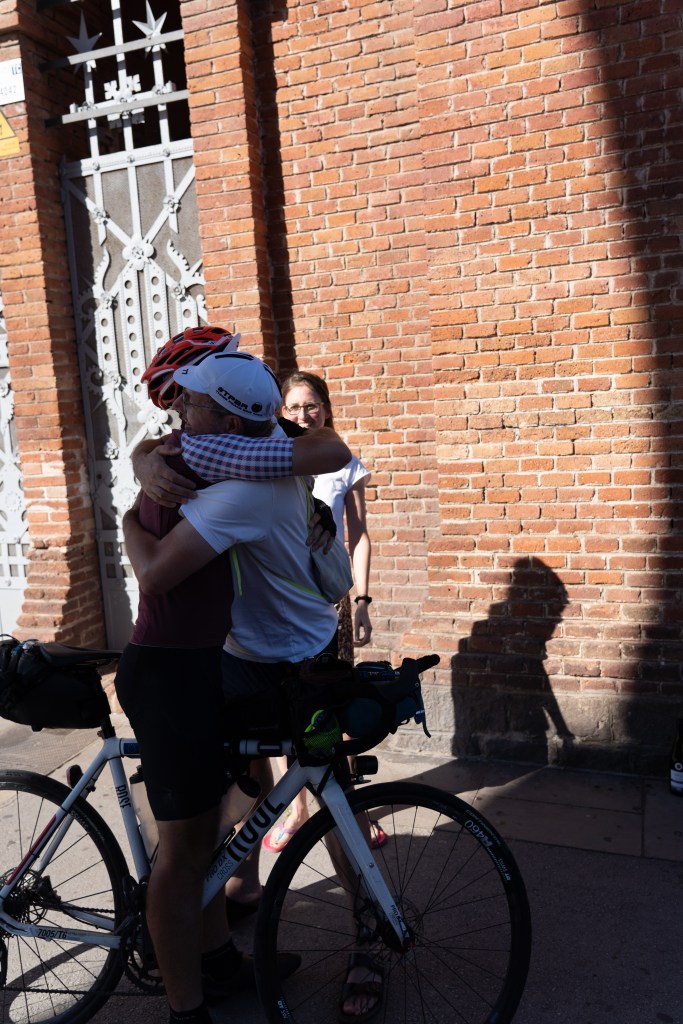
Hell yeah! I FINISHED The Transcontinental Race 🙂 – on Monday 8.8.22 after 14d14h21m (14,6d) and 4194km/38056m (av 287km/2600m /day), as the 66th out of 250 solo-starters – the moment of arrival was emotionally very intense to me: of course the joy of having finished, and being „home“ with friendly and familiar faces; but also the infinite relief of finally being physically safe… the last 2-3 race days had thrown some heavy moments and circumstances at me… one driver to finish despite my pain and stress of those last 2 days was simply to be in a friendly environment. And that’s what this community really is.

Overall I‘m very content with my race. I was mentally mostly in a very good space. I realized how my riding has matured over the past 4 years since my first race (TCR No. 6); more continuity, more rationality and better decisions and self-awareness. The landscapes were largely stunning (e.g. Passo di Gavia and Durmitor). Not a single mechanical or flat tire (just added 1bar of air 2-3 times). Only the last 2-3 days were dark: incredible knee pain so I had to fight for every pedal stroke, the “baseball bat incident” (check out this Instagram-Reel for more information), horrendous traffic, tough road conditions and dog chases (although I managed to handle the dogs quite well this time). But I was determined and just about made it 💪

Thanks to all the kind people on location; fellow riders (you’re an amazingly special bunch!), organizers, volunteers, photo/press team. And also: Thanks to YOU! Followers and dotwatchers, both virtually and at the side of the road! For your interest in my journey, your encouragement and your sympathy. Without it I *may* have scratched.

All pictures taken by Sam Gate; thank you!

Today (Tuesday, 9.8.22) I just chilled with other riders, went for a swim, welcomed friend Amy Lippe at the finish line, ate icecream and tons of other food. Now off to bed, tmrw visiting Burgas.

Notice one thing? Yes.. my plans don’t involve any cycling 😂

Strava records…

I will probably do a proper write-up or some other recap-format for my race. For now, here you find the embeded Strava records. Please note: due to a technical error, Day 1 is incomplete; it was actually in total 430km/1636m on that first stint from Geraardsbergen to Warburg in the middle of Germany

https://strava-embeds.com/embed.js

03 TCR08 – Equipment & Packing List

You’re now at post 02 of my TCRNo8-series. To jump to all so far existing posts on this in chronological order:
01 TCRNo8 –About the Race & Live Tracking (Cap63) – Start: 24.7.
02 TCRNo8 – My Rider Introduction

03 TCRNo8 – Equipment & Packing List


This post is largely copied and from my Transiberica 2021 gear / packing list post, and then altered to be up to date. it is now a summary of my gear. If you want to go into more detail on some items (wheels, lighting, shoes, gearing, etc…) I suggest you check that post: Transiberica Equipment & Packing List, 2021. And for even more information, also on my preparation (route planning, training), I suggest you check this one: Transcontinental Race preparation, 2018 (it is a few years old, but my approach was good and I did it similarly this year).

This Year’s Bike and Setup

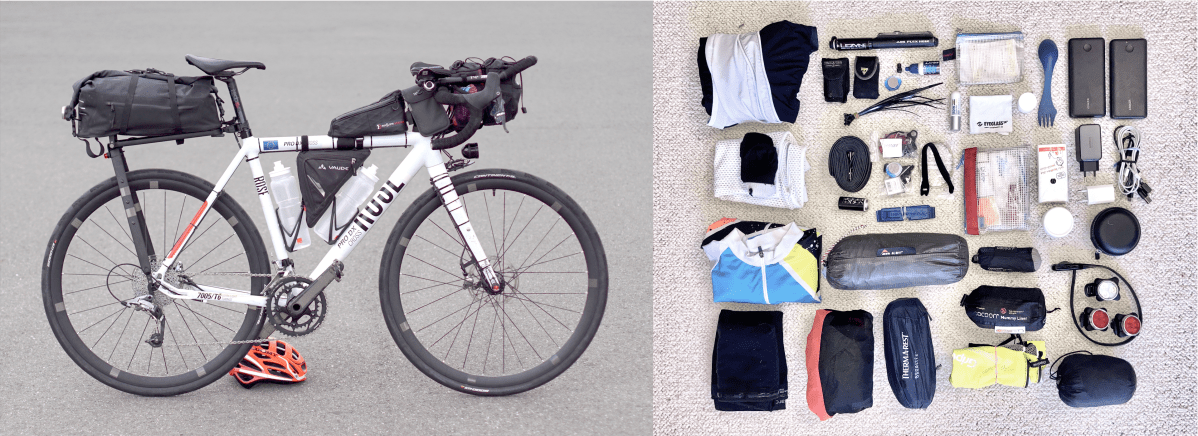
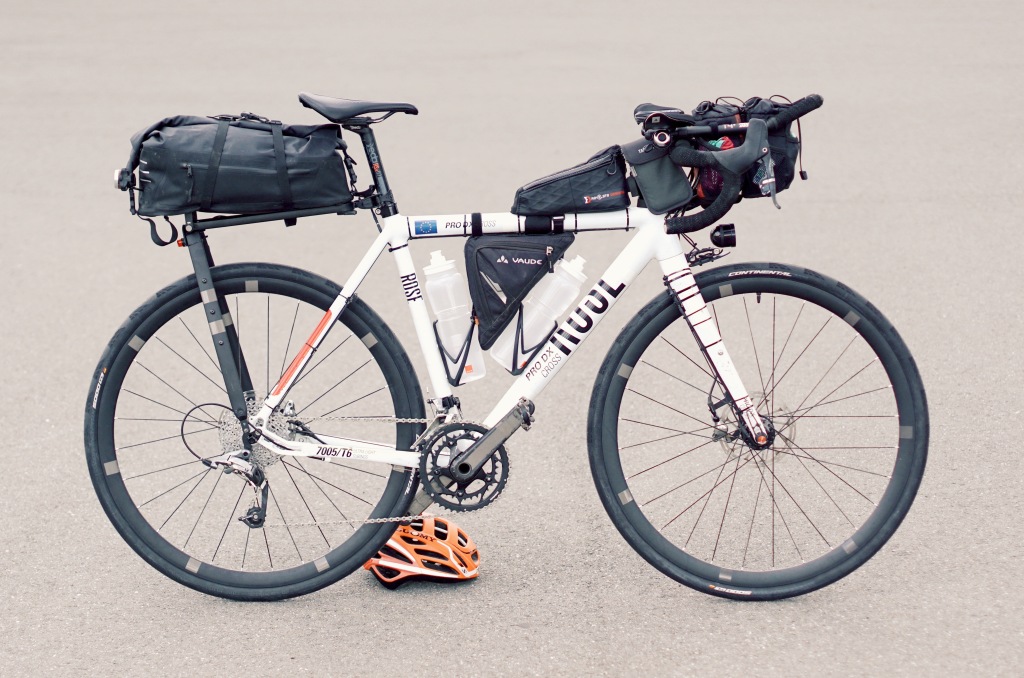
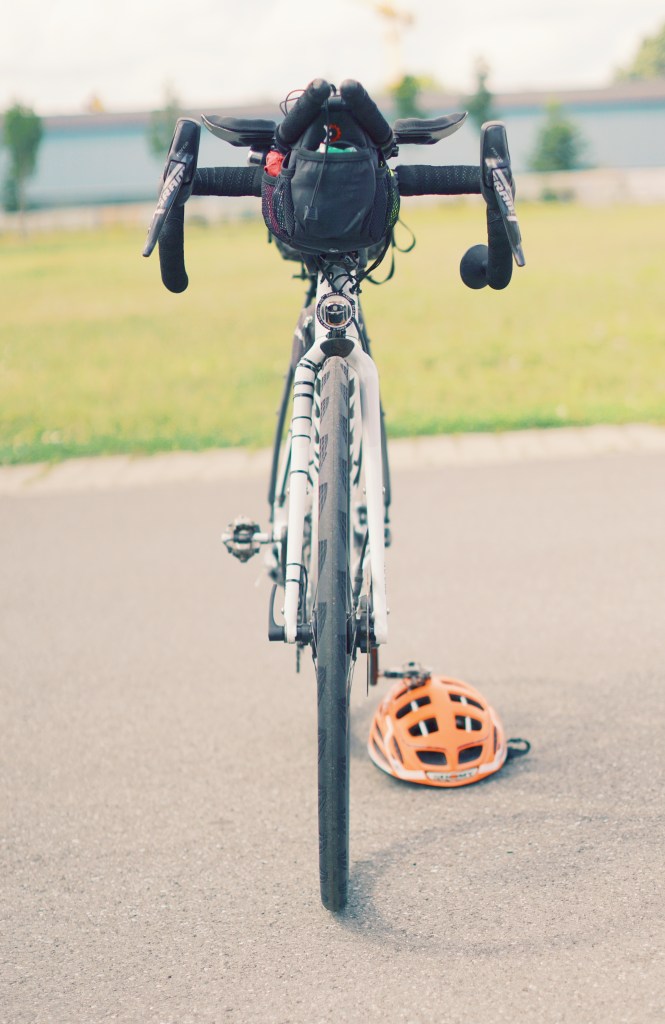
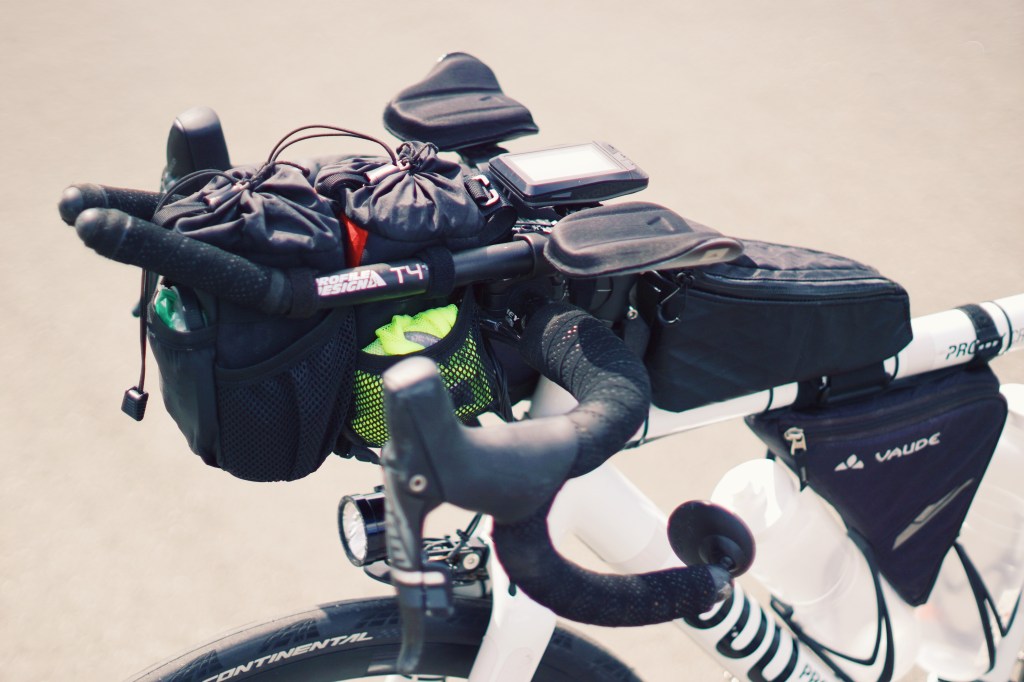
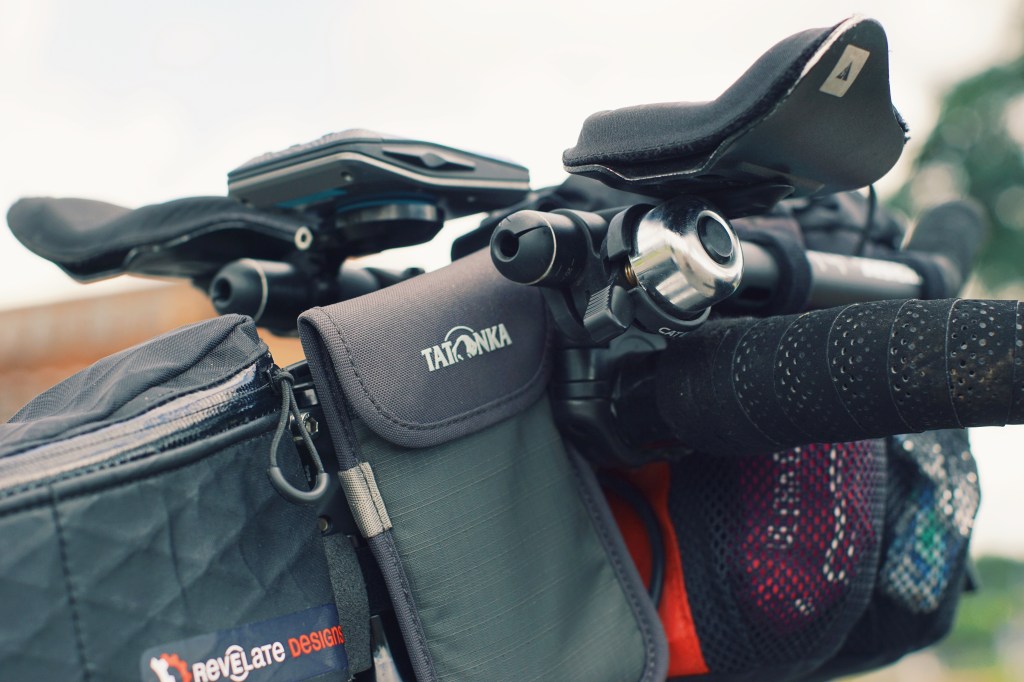
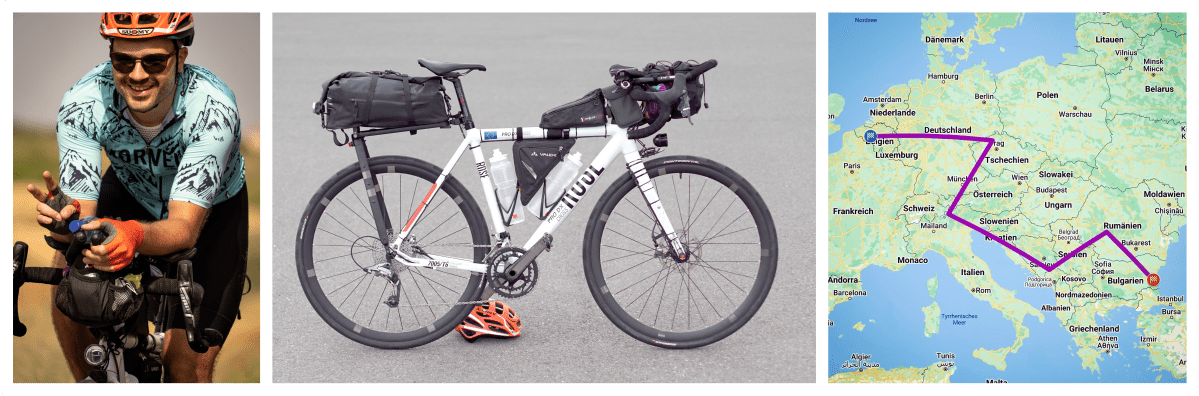
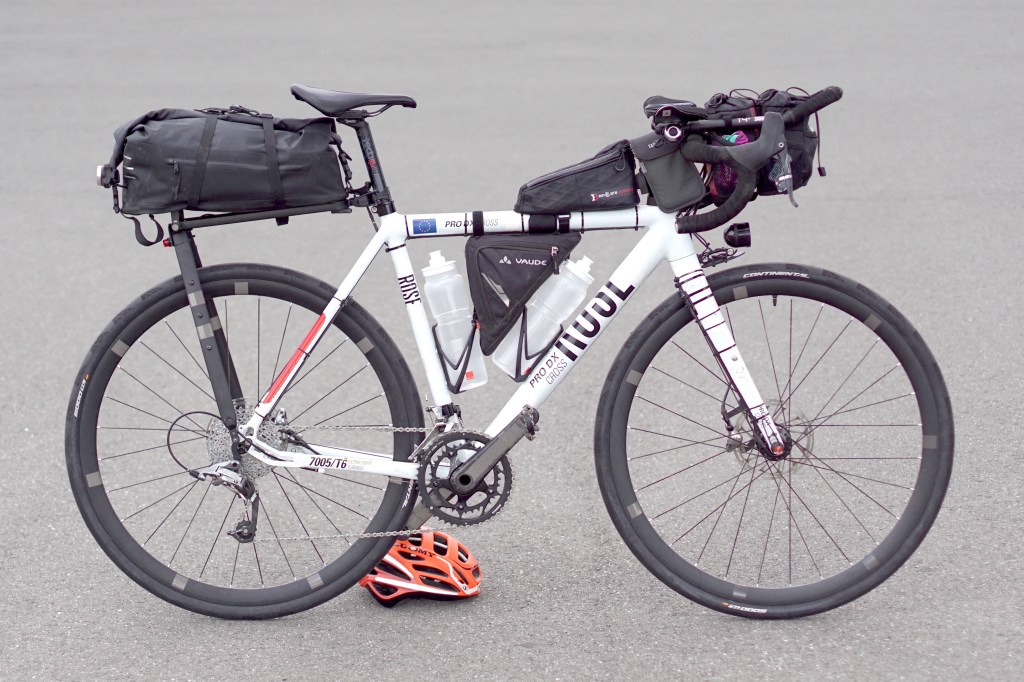
Of course: My Rose Pro DX Cross from 2015, but I just call her lovingly „Rose“ <3. Rose runs on Sram Force22 (disc) and has an alloy frame and carbon fork that stood the test of many adventures. Her custom compiled gearing of 46/33 (front) and 12-36 (rear) will hopefully get me up allll the climbs while still allowing me to pick just the right cadence/force at any point (no large gear jumps). For comfort, Rose is equipped with Schwalbe Pro One tubeless tires in 32mm, a Redshift ShockStop suspension stemProfile Design T4 aero bars, a Specialized Power saddle and gel pads under the bar tape. I decorated Rose with tons of reflective tape, but my favourite accessories are still: a little rear mirror and my not-to-joke-with bell that is modestly hidden under Rose’s elbow pads.

Rose Pro DX Cross

WEIGHT:
– bike only: 10,8kg (without bags and rack, but including all adjustments like aero bars, dynamo, light/electronics, pedals etc…)
– bike with empty bags: 12,4kg (incl. Tailfin rack)
bike with luggage: 16,5kg (excl. food & water)

And some more kit…

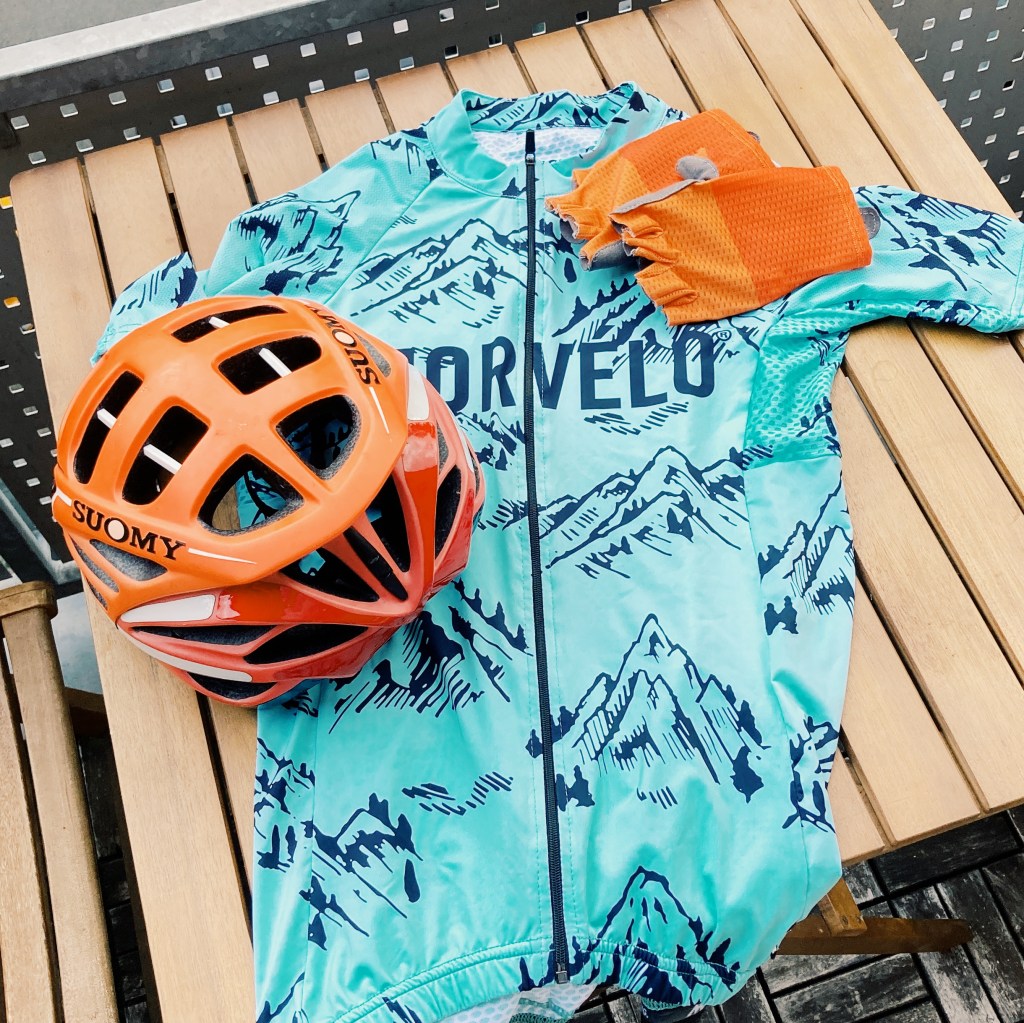
This season’s kit colours: turquoise/orange for the jolly Miamy look to lighten my mood when necessary (or yours) and for good visibility. Additionally I’ll bring an funky VOID jersey that I wore already on my TCR06 in 2018 and still like. I will ride my local cycling club’s team bibs by Vermarc. Shoutout to RTC dasimmerdabei e.V.!

Morvelo summer jersey, LaPassione Duo Gloves Orange, Suomy Gun Wind helmet

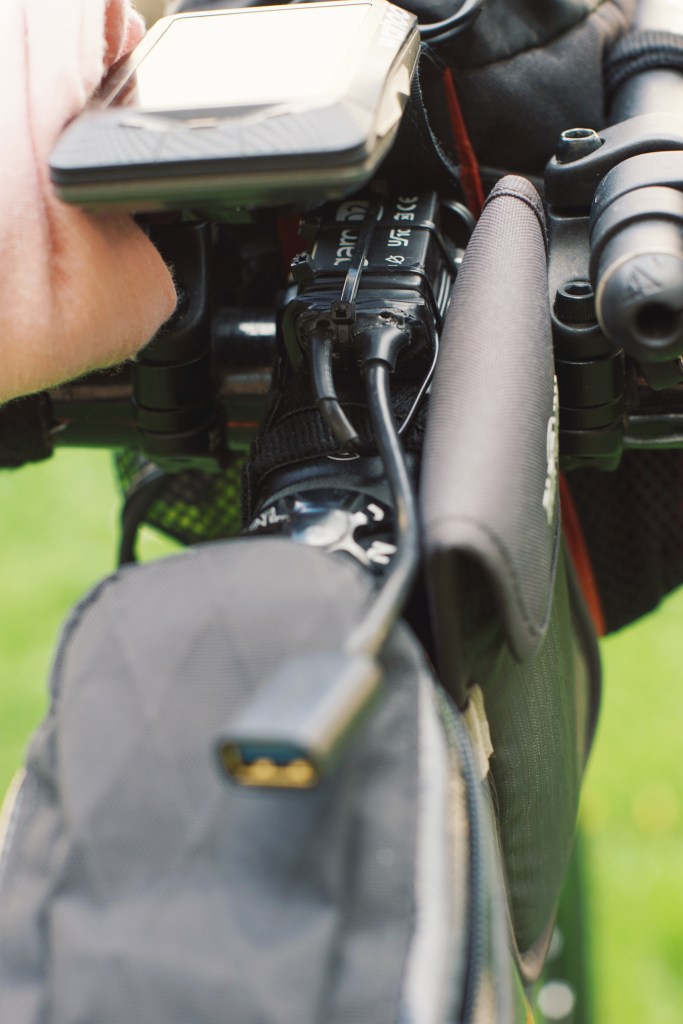
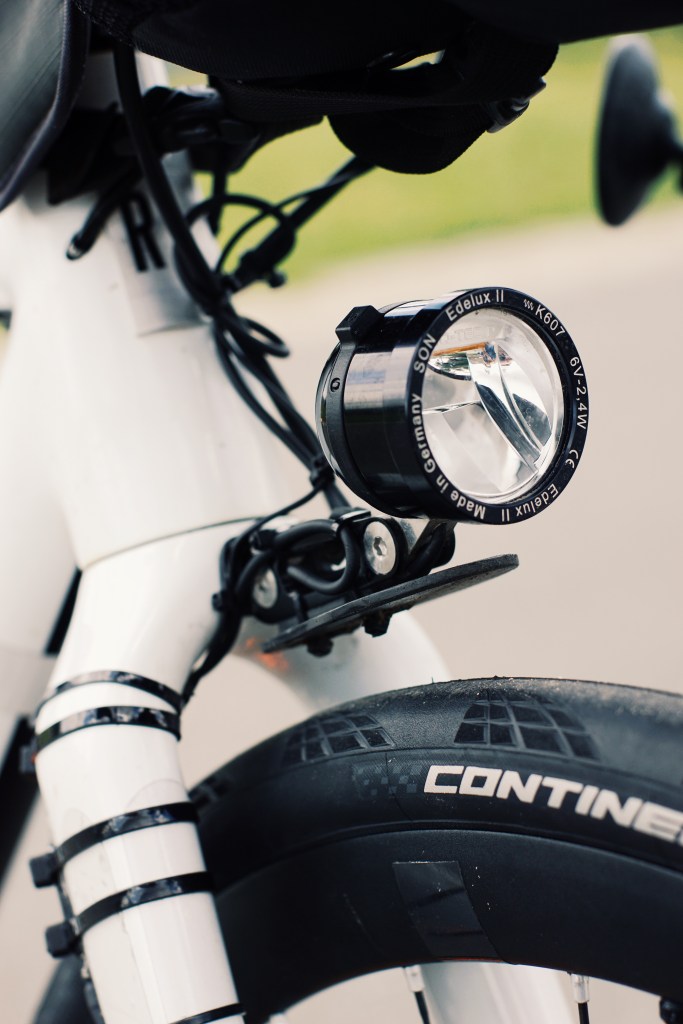
My bedroom consists of a bivy, light mat & silk liner + boxers & shirt dedicated to clean sleeping. My Wahoo Elemnt (+ phone backup) in combination with a SON dynamo hub and Edelux II light will show me the way while an Igaro D2 USB-charger, two 10000mAh powerbanks (by Anker) and a strong 65W charger for quick charging will make sure I never run out of juice (was on the edge a few times last year on my Transiberica). A carefully curated bike-mech/spare-parts compartment (incl. rear derailleur hanger, spokes, etc.), and babywipes/chamois cream/ointment will rule out most show-stopping technological or biological malfunctions.

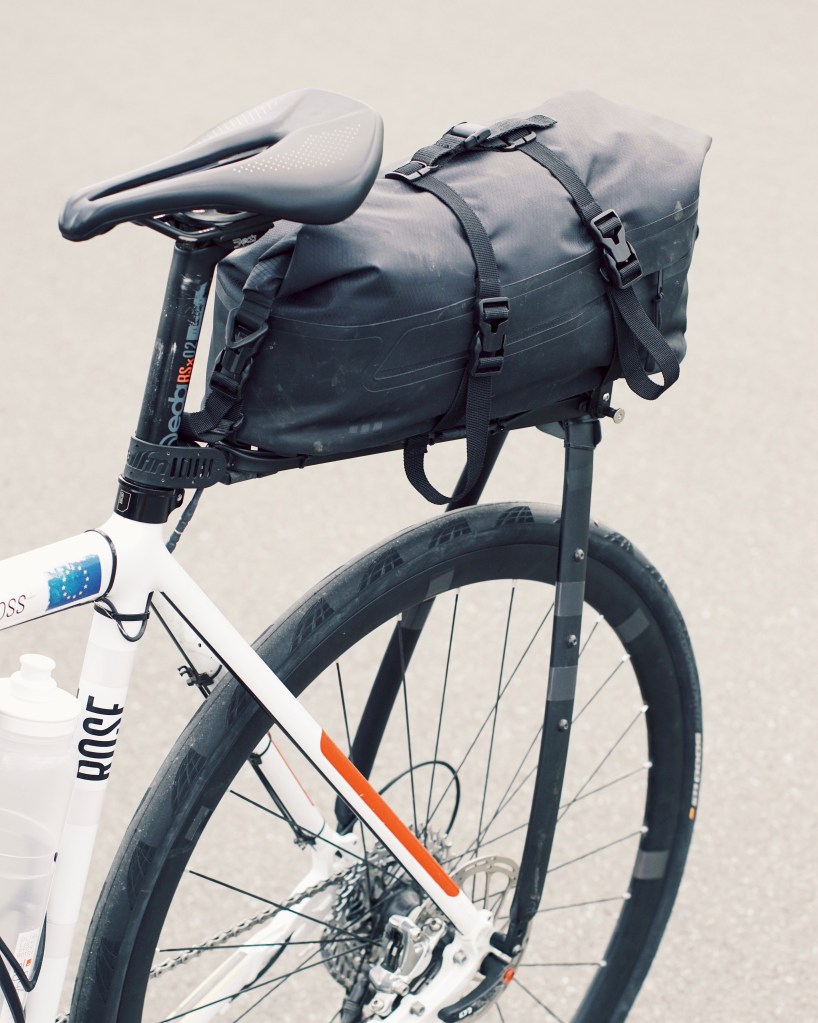
The bags are arranged to reduce the frontal area (aero) and optimize accessibility: 2 food pouches in-line between the aerobars, a fuel tank and phone sleeve behind them, small frame triangle to still make 2x 1L bottles fit, and my aluminum Tailfin rack & trunkbag that did an amazing job on past endeavours.

very small frontal area

What’s new? (gear-wise)

Got a new rain jacket: Gore Wera Torrent. But apart from that: Nothing really. My setup on Transiberica worked really well. It is not super duper light/compact. But gives me enough comfort while not being too bulky.

But if you wish to check my reasoning for certain gear choices and changes, I suggest you check these two older posts from past races:

Tailfin Alloy trunkbag & rack http://www.tailfin.cc
Cockpit with two Revelate Designs Feed Bags between the aero bars
Shimano XC7 shoes – SPD system
Igaro D2 USB charger for charging devices from the dynamo.
SON Edelux II connected to SON dynamo hub
Revelate Designs Gas Tank & Tatonka phone sleeve

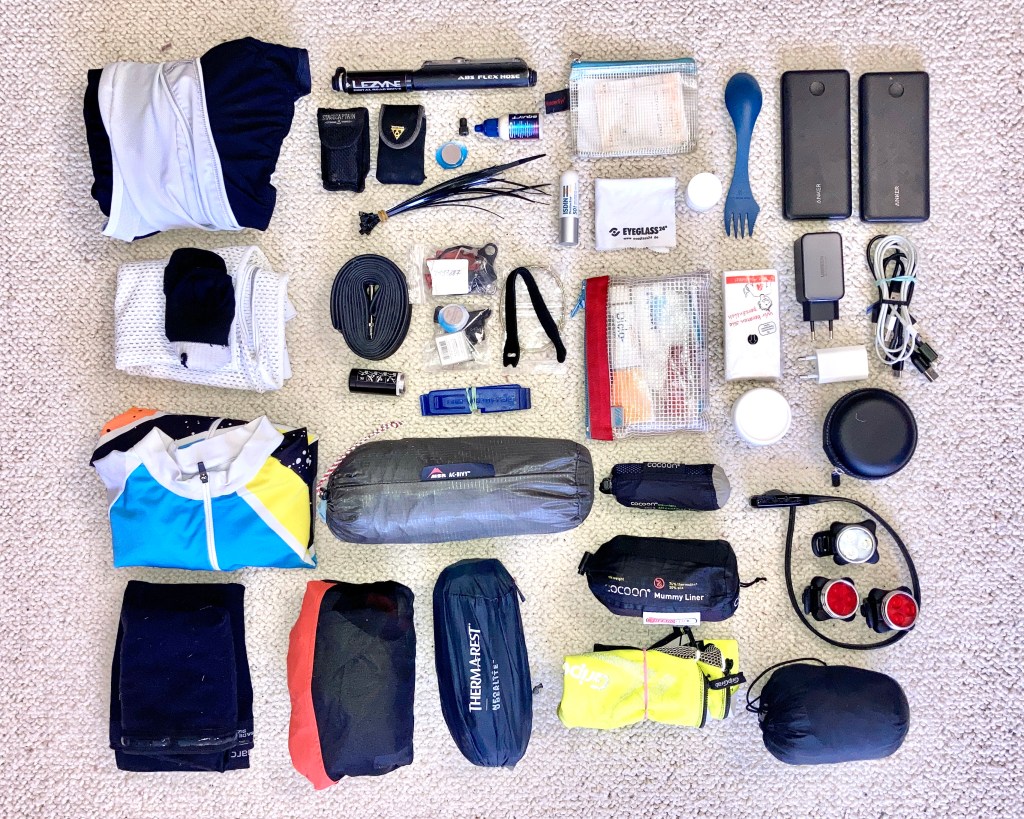
Packing List

missing on this pic: boxers & t-shirt for sleeping (forgot it)

Documents

  • ID card
  • hardcopies of documents (incl. Corona stuff)
  • health insurance card
  • contact details
  • pay cards
  • some cash

Electronics

  • iPhone SE (with offline-route backup on maps.me)
  • Wahoo Elemnt (updated & with routes)
  • headphones Shure SE215 (bluetooth)
  • USB charging cables
  • 3 port USB charger (65W)
  • 2 Anker power banks 10000mAh
  • iPhone cables, 1 short & 1 long

Bike maintenance

  • mini leatherman (no name)
  • multi tool (Lezyne)
  • air pump (Lezyne, with digital pressure gauge)
  • puncture set (incl. tubeless plugs etc.)
  • 2 tire levers
  • cable ties (many!!)
  • spare shoe lace
  • Sram chain link
  • rear derailleur hanger (bike specific)
  • gear inner cable
  • chain lube (Squirt dry lube)
  • replacement spokes & nipples
  • 2 pairs of brake pads
  • schrader valve adapter (to use gas station pumps)

(Spare) clothes

  • Buff merino multipurpose head scarf
  • spare socks (Assos summer socks)
  • spare bib-short (Vermarc)
  • spare base layer (LaPassione summer)
  • arm & leg warmers (Vermarc)
  • down vest (Endura)
  • rain jacket (Gore Torrent)
  • high visibility vest
  • boxershorts / T-shirt (for sleeping)

Hygiene

  • toothbrush (cut off, obviously ; ) ), toothpaste, shampoo
  • Ibuprofen
  • Diclophenac cream
  • wound healing cream (Bepanthene)
  • baby wipes
  • tissues
  • chewing gums
  • chamois cream
  • sun protection lip stick, & healing lip stick
  • micro fibre cloth (for glasses)

Sleeping gear

  • silk liner
  • sleeping mat (Thermarest ultralight)
  • bivy (MSR AC bivy)

Miscellaneous

  • 2x 1L-bottles
  • Hiplok (small cable tie lock, number lock)
  • spork

Wearing

  • helmet (Suomy Gun Wind)
  • Glasses: Adidas Proshift with photochromic prescription lenses
  • short gloves (LaPassione Duo Gloves; light padding)
  • bib-short (Vermarc)
  • short jersey (Morvelo summer)
  • base layer (LaPassione summer)

Human Encounters – mini-post about meeting fellow riders & volunteers on the road

A mini-post about: *human encounters* in self-supported endurance (e.g. Transcontinental Race)

Fellow riders on the road by the nature of it understand so well the experience of a race. That’s why encounters on the road are so deeply special: No words needed to express how rough the last night was, how beautiful the descent, how mesmerizing the landscape, how pain- and doubtful the last morning, how itchy the bibs. Because all of that is tacit common understanding among riders and creates an immediate connection.

On top of that, based on my experience, riders of these races are a special and pleasant bunch: many in touch with themselves, curious and (often calmly) enthusiastic, humble because they got to know their limits so many times, and all that is why they’re part of the race in the first place. “Sociable loners” as Anna Haslock (of @thetranscontinental ) once phrased it.

Now imagine..: a trip where both your inner and outer world are constantly in flux… and then you bump into a fellow rider, maybe one you’ve already met 400km ago. These are “home” moments. A landmark in time that makes you look forward to the next one and socially contextualizes the route between now and then.

A similar connection occurs with media teams on the road, and volunteers at Checkpoints: they have seen so many riders and the same landscapes, that they look beyond the obvious craziness of such a race, naturally empathizing more with the acute emotional state of the rider they encounter. Especially volunteers: from their position of stability they manage to get us back on the ground when we may feel there is none.

I’m grateful for these social experiences. They make these races what they are beyond „just“ tough rides. 🙏

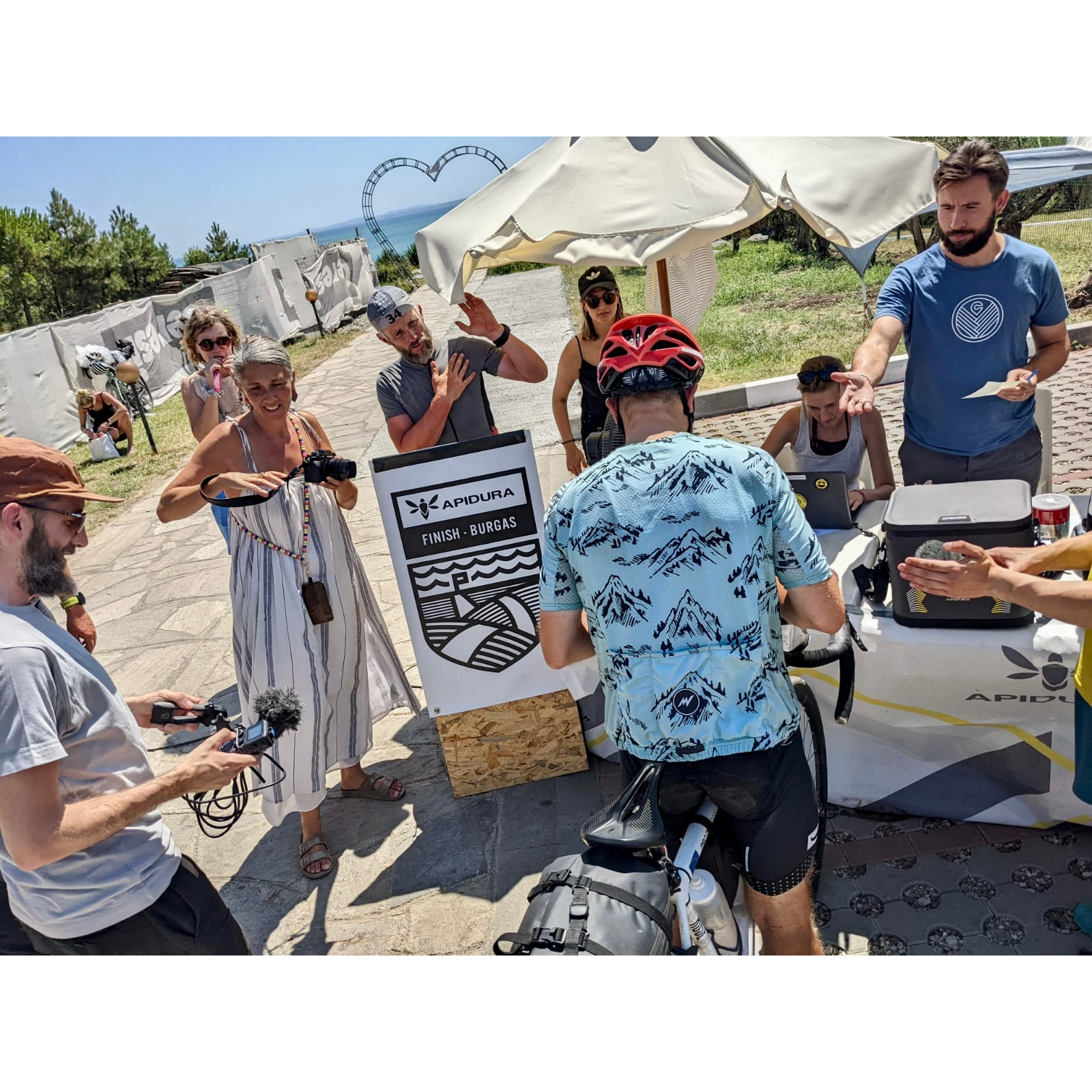
The above pictures were taken by the kind media crew of @transiberica_club (www.transiberica.club) in ‘21. You see Julio (cap28) and myself at Checkpoint 4. 7:30h in the morning. We both and the media crew had a rough night for sure, the desert was still cold, a long hot day ahead. We simply had a good time in that moment.

See you on the road!

Malte, Cyclingtourist & #TCRNo8cap63

02 TCRNo8 – My Rider Introduction

You’re now at post 02 of my TCRNo8-series. To jump to all so far existing posts on this in chronological order:
01 TCRNo8 –About the Race & Live Tracking (Cap63) – Start: 24.7.
02 TCRNo8 – My Rider Introduction

03 TCRNo8 – Equipment & Packing List


The organization of The Transcontinental Race asked all riders to publish a brief introduction on their social media. Here is mine… copied from my Instagram @maltecyclingtourist

Hello!!

picture by http://www.transiberlica.club @transiberica_club

#tcrno8riders #tcrno8cap63

Hi there I’m Malte „Cyclingtourist“, Cap63 and at heart exactly that: a cyclo-tourist & explorer; things just turned up a gear (pun intended) over the years. Had miraculously brought myself through TCRNo6 and 2 other races that taught me a lot, and now back at „the“ race, TCR! Super excited to meet old and new fellow rider-friends and all volunteers & team on the road & in Burgas! 👋

BIKE

I simply feel at home on Rose 🌹. She’s set up with all kinds of perks for comfort: custom gearing (Force22, 46/33 + 12-36), Rockshift suspension stem, 32mm tubeless Schwalbe Pro 1, padded bar tape and aerobars, Specialized Power saddle and overall perfect geometry in all positions. My favourite accessories however are: her little rear mirror and modestly hidden but not-to-joke-with bell.

Setup

SETUP: SON dynamo and light, Igaro D2 dynamo charger, 2 power banks. Tailfin, small frame triangle, 2 Revelate Designs food pouches & fuel tank, all set up for small frontal area & easy access. Bedroom: mat, bivy, silk liner, dedicated boxers/t-shirt.KIT: cyan/orange for the jolly Miamy look to lighten my mood when necessary (or yours) and for good visibility. Bibs: now in team kit of my Cologne cycling club 🧡 (shoutout @rtcdsd )

RIDING STYLE

Rather impulsive, luckily it got a bit better over time. My performance over the course of a race is usually very volatile; my specialty: catching up with long mid-race night rides. As I love independence and flexibility, my setup is designed to sustain me for a few days outside between the occasional BnB nights.

TRAINING

On the positive: I generally have a crappy diet, so I’m perfectly prepared for running XX days on 7day-Croissants, Pringles and Coke. On the negative: my cycling season tends to start… late. One doesn’t ask a gentle(wo)man for their yearly mileage. I tend to compensate for it with my enthusiasm and curiosity to do it.

Can’t wait for all the landscapes, people, ❤️ on the road, interaction with dotwatchers. Shoutout also to Dragan 🐩 & Cruella 🐕, the 2 stray dogs that will make me loose my day‘s food pack at 1:35am on day 8.

01 Transcontinental Race No. 8 –About the Race & Live Tracking (Cap63) – Start: 24.7.

You’re now at post 01 of my TCRNo8-series. To jump to all so far existing posts on this in chronological order:
01 TCRNo8 –About the Race & Live Tracking (Cap63) – Start: 24.7.
02 TCRNo8 – My Rider Introduction

03 TCRNo8 – Equipment & Packing List


Something new is on and I can’t wait for it to start! I have the immense privilege to ride the Transcontinental Race No. 8 – one of the most iconic cycling races in the world. HELL YES, I’ll do it again. I’m as excited as I am humbled.

My personal background: In 2018 I already joined and finished the 6th edition of the race. In the meantime did two other races (Blog entries/information here: Three Peaks Bike Race 2019 & Transiberica Bike Race 2021). Now – through the lottery and maybe aided by the fact that I successfully finished my first TCR – I am privileged to be granted a placement to ride it again.

Here you first find some information on what the TCR actually is & how you can live-track my “dot” on the map, if you wish. In case you‘re interested in my gear or my rider introduction you find the links to post 02 and 03 above at the beginning of this post.

Transcontinental Race No. 8 – facts & figures

The Transcontinental Race is a (attention please…) self-supported free-route ‘ultra’-endurance single-stage bike-packing time-trial in the spirit of Mike Hall† (who founded this race, and is one of the founders of this sport and scene). That means…

  • Start: Geraardsbergen/BelgiumSun. 24th of July 2022, 22:00h
  • Finishline: Burgas/Bulgaria, whenever riders arrive.
  • 4 Checkpoints (CPs) spread over middle and eastern Europe to be approached in this order:
    • Start Geraardsbergen
    • CP1) Krupka/Czechia
    • CP2) Passo di Gavia/Italy
    • CP3) Durmitor/Montenegro
    • CP4) Transalpina Strategica/Rumania
    • Finish in Burgas/Bulgaria.
  • free route choice, except for a compulsory parcours at each Checkpoint (ranging from 40km to 120km)
  • over 4.000km and 40.000m cumulative climbing
  • self-supported, i.e. carry your own luggage, no outside assistance, no rider-cooperation, no supply pre-arranged
  • single-stage, i.e. the clock never stops; there are no fixed stages or stops, neither for sleeping nor for food etc.
  • ca. 275 participants (28 of which riding as pairs, all others solo), all genders competing in the same category
  • more detailed rules: see here

A spectator sport! – How to follow the race and riders in realtime

Despite the geographical spread of the events, endurance bicycle racing is a spectator sport, because: Each rider has their own GPS-tracker. Your chance to kick my a** when I hang around for too long at McDonald’s or oversleep in the ditch!

Additionally the race in general it is vividly accompanied on social-media:

I’m always happy to hear from you. Encouraging messages, cheering, etc. are highly motivating (also to the other riders!). I may not always be able to reply immediately, but be sure I read messages and mentions with great pleasure!

03 Transiberica – The very late post-race post

You are now at post 03 of my Transiberica series. If you want to check them out in order, voilà:
01 Transiberica Bike Race 2021 – Live Tracking (Cap33) & About the Race
02 Transiberica – Equipment & Packing List
03 Transiberica – The very late post-race post


Dear readers, and dear diary (after all, that’s what this blog is, too), I thought..: why not speed things up? I had published my Transcontinental Race 06 report 1,5 years after the race (it still found many readers and I got a lot of positive resonance about the format. Thank you!). So with this post coming ca. 3/4 of a year after my Transiberica 2021 finish I’m reducing the delay by half!


PODCAST: Before we start… to my German speaking readers: Last October (2021) I had been kindly invited by Pascal of the Gravel-Podcast who interviewed me about my Transiberica Race – it was great fun. In that episode you find a lot of information, anecdotes and also more general things, that you will not find in this blog post. So, if you’re interested you may want to have a listen. Viel Spaß!
“Gravel-Podcast – Die Transiberica ist immernoch in Spanien”


Now my actual blog post:
I will not bother you with a detailed daily report of my race. On 10 days and 3000km there are simply too many things happening to do them justice in a report that anyone would still want to read. With my interactive Transcontinantal-Race-map I had already found an alternative way to take you by the hand on my trip but still spare you hour-long reads. …and I have a similar goal this time, but by different means:

  • 03a) first: a few words on my most important takeaways
  • 03b) my Instagram-stories from during the race – because in this case both their form and their content are closely linked to my race experience. I will explain…
  • 03c) facts & figures, Strava tracks & short reports & pictures: some stats and a map that summarise my race, some photos, the daily Strava-captions and links to each stint on Strava where you find more information and also more pictures.

03a) My most important takeaways from Transiberica 2021

I think all “ultra” (whatever that means) endurance racers can relate: You proudly accomplish your first race, and then the idea is:

Let’s do this again, but better.

In my case the first race was the Transcontinental Race 06 in 2018, and “better” meant to me: largely reduce my suffering / increase my enjoyment and increase my daily mileage. In between I had the Three Peaks Bike Race 2019, which I finished, but did not really improve any of those factors due to an injury-induced lack of training before hand. But 2021 was my year to seriously tackle that “better racing” mission.

I had a few goals:

  • sleep better and more regularly
  • more efficient riding through less stopping time – make 300km/day
  • focus more on enjoyment, moments, landscapes, the social element. Do not “celebrate” suffering but instead avoid it as much as possible.

And to get right to it: I mostly succeeded!

Sleep better

I slept every night (more or less) either bivaking outside or in BnBs. I underestimated how cold it would get at night in the dry and elevated landscapes, so I certainly had a few miserable nights. But I took rests, and was mostly somewhat revived for the next day. Usually I rode on until at least midnight, and got up again a few hours later. BIG improvement over my Transcontinental Race performance where I often rode through the night and had very ineffective next days, with huge fluctuations in daily mileage and even sleep induced crashes (see my TCR blog post/map).

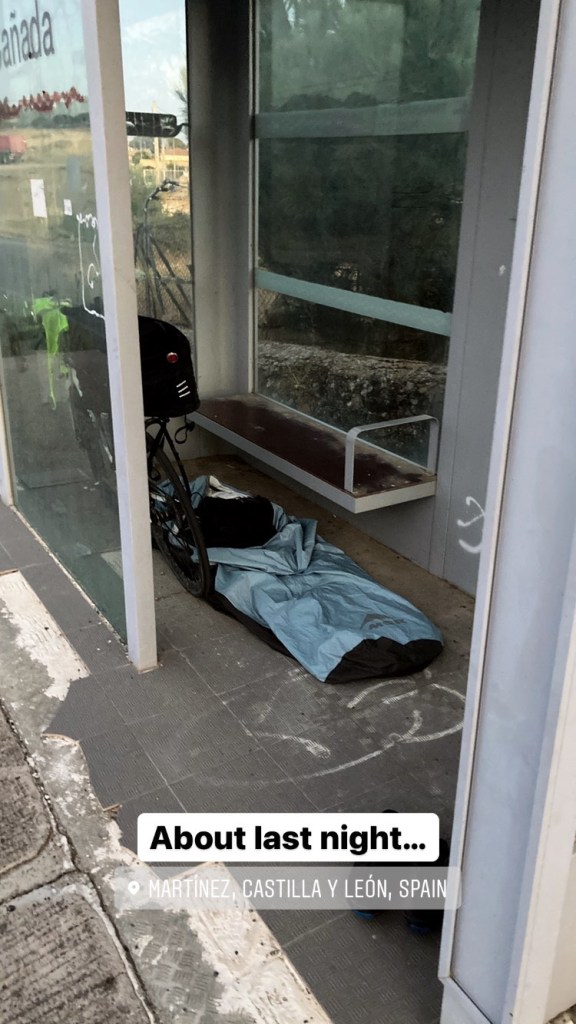
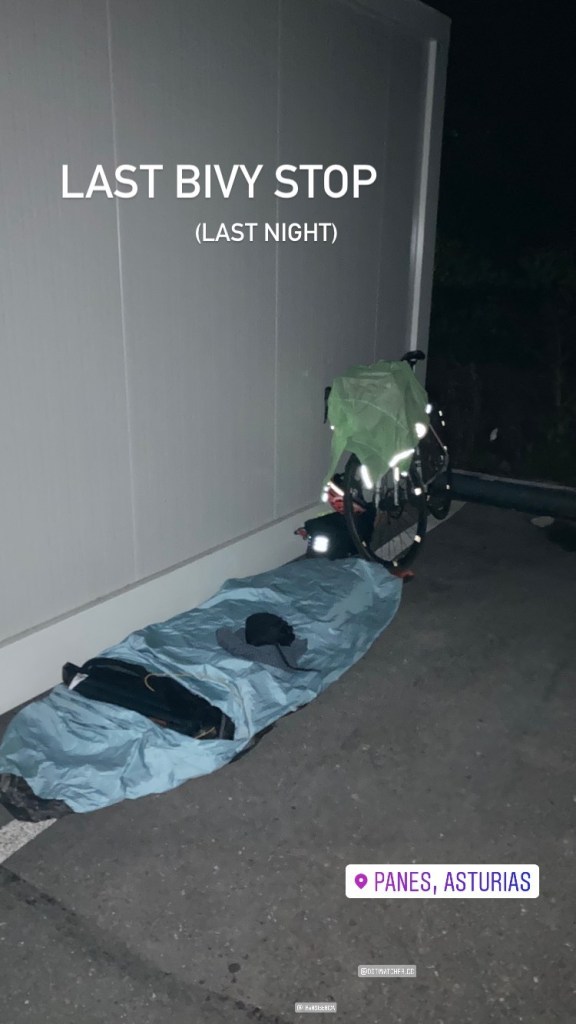
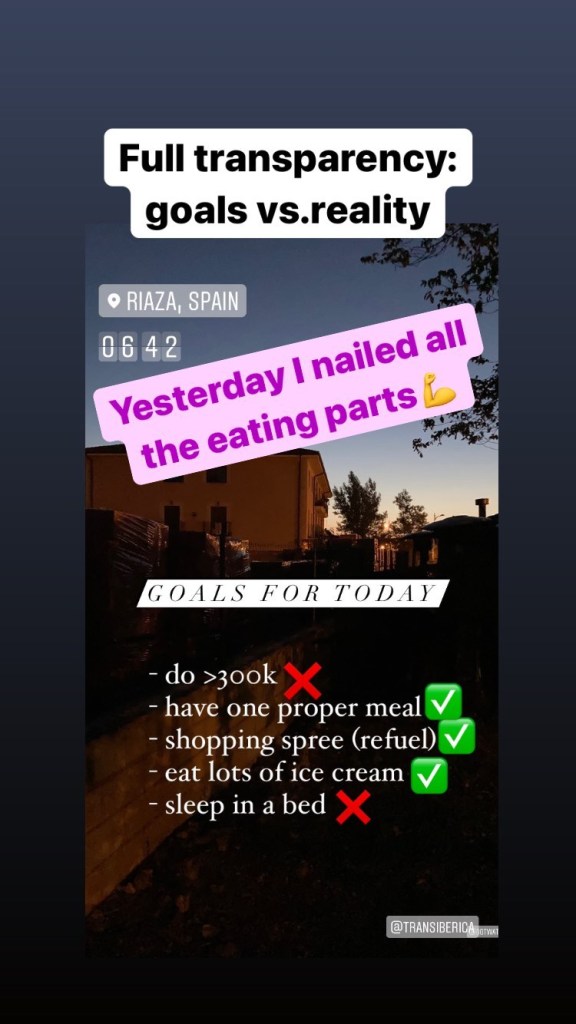
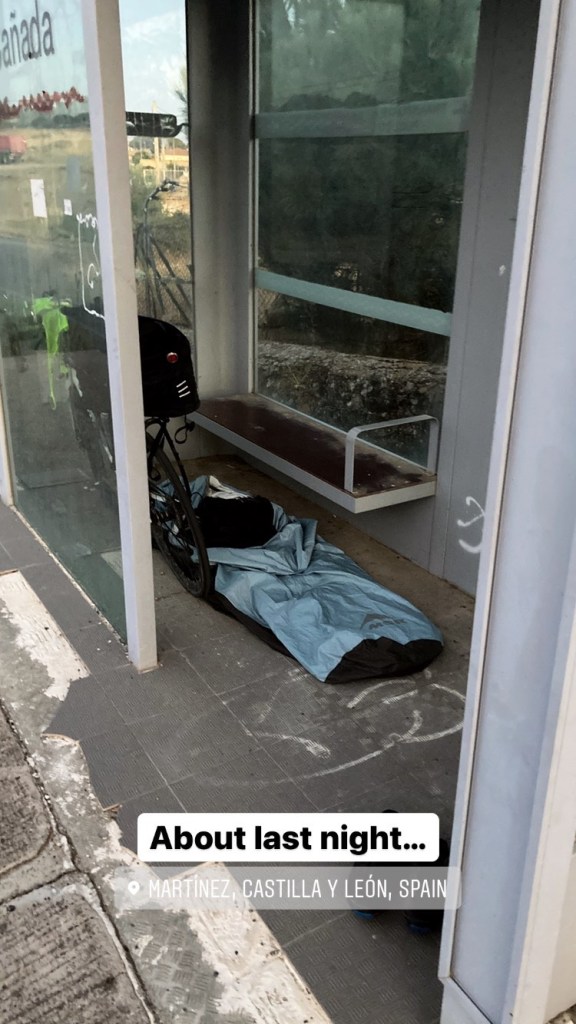
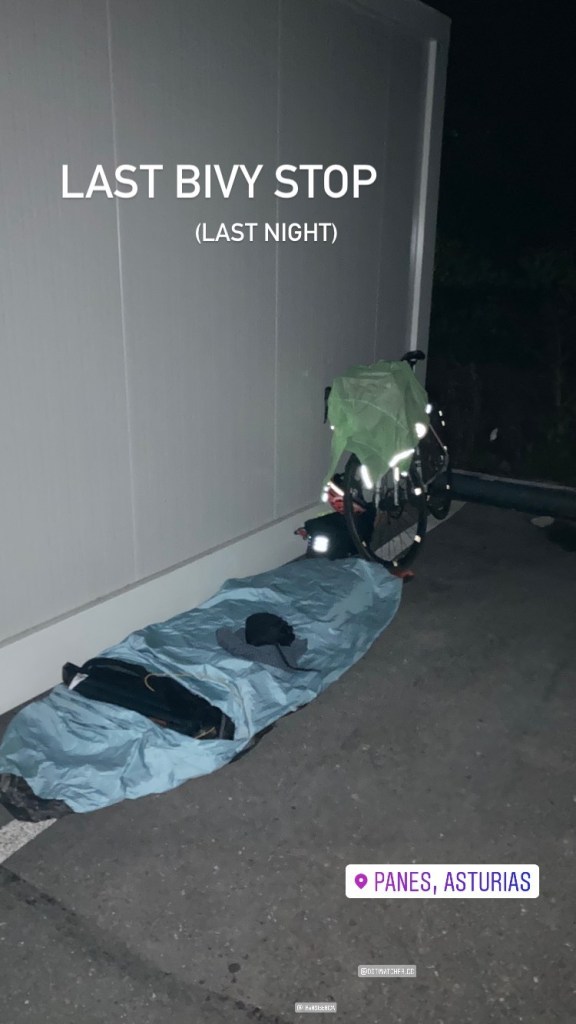
Sleeping spots outside ranged from bus stops to parking lots to football fields. Since large parts of the Spanish Peninsula is a plateau at a few 100 meters altitude and additionally very dry (sometimes deserts, cooling down quickly) or at rivers (i.e. cold & humid), it got incredibly chilly at night. With only my bivak, silk liner and sleeping mat I was clearly under-equipped and often declared my sleep over just because I wanted to cycle to warm up; i.e. bad conditions for sleeping, good conditions to get up early and make some mileage. Still… I had rest, slept or at least closed my eyes and that was enough to not be sleepy the next day. I guess my average bivak sleep was 4-5 hours. I slept 7 out of 10 nights outside.

Proper beds I found mostly through booking.com in affordable hotels. 3 out of 10 nights I spent in beds. Having a shower, charging devices, and having a literally clean and fresh start for the next 2-3 days. While sleeping in proper beds my average sleep was probably around 8 hours.

Only in two instances I was very close to falling asleep on the bike – that was in the two last nights: On day 8 I did a massive stint and in the end managed to catch up with some riders by doing some good old night riding. That day I had checked both Checkpoint 7 (Portugal) & 8 (back in Spain) that included two massive climbs. I was on top of CP 8 at midnight, full moon and Venus in the night sky – what a view and feeling, especially combined with the accomplishments of the day. At altitude I branched off from the road to take a hiking route through the wild mountain landscape into the very end of a long valley, because this would allow me to ride downhill almost entirely until CP 9 and saved me about 2000m of climbing. So I had already done 250km and 4700m of climbing that day, then that hike over rocks and dirt tracks and super challenging rubble descent into the last village of that valley, so was crazy exhausted. Weird feeling to arrive in that village – like an alien intruding human civilization and a random landing spot. Anyway: The valley went along some water stream, so it was very cold, humid and foggy – i.e. a kind of coldness that really gets in your bones. Since it would have been too cold for me to sleep anywhere I was forced to continue cycling until the villages got a bit bigger and the valley a little bit wider until I found a little square far enough from the water so the temperature at the sleeping spot would be a bit milder. That feeling of riding when you’re dead tired, after 8 straight days of cycling, the massive stint that day… your eyes just want to close. And they do, and all you can do is talk to yourself, shake your head, listen to loud music, scream sometimes just to get your adrenaline up again to keep you awake. Delirium – surreal. All that on pitch black, smoothly paved valley roads in the middle of nowhere, a slight decline pulling you forward; like on a monotonous highway.

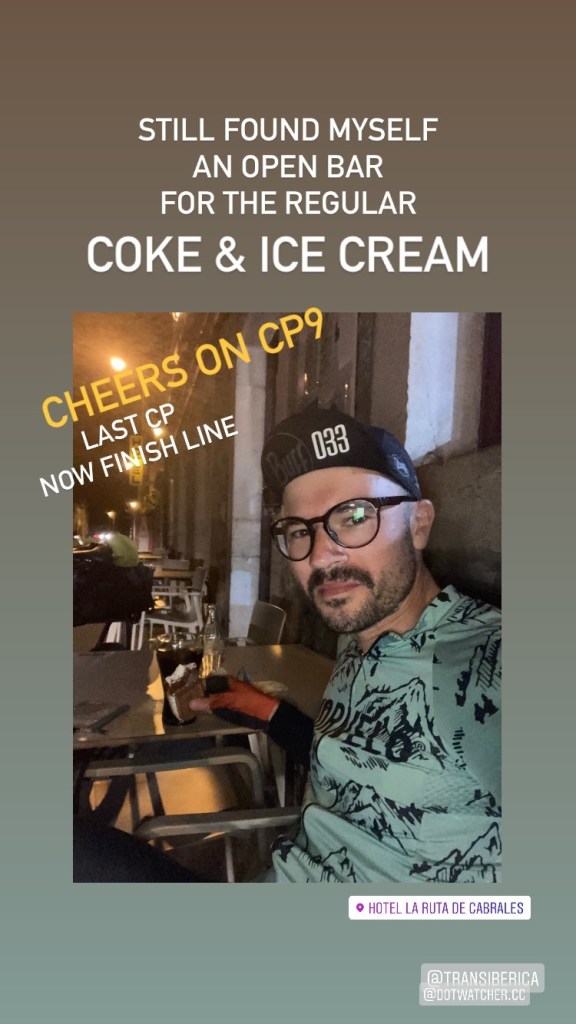
The other instance where I got too close to falling asleep on the bike was the following and last night, after day 9. Again I had another massive day behind me with 320km and 2400m of climbing, including the super challenging Checkpoint 9 climb. The conditions were similar to the night before. I wanted to ride on for as long as I could so I’d have as little mileage left for the next and last day to the finish line. So I moved on, but got somewhat trapped in a similar situation: cycling along a valley with a river that made it too cold and humid to sleep. Again battled my eyes closing (failed a few times, but just about did not crash), stopped a few times to kind of pep-talk and collect myself, until I finally found a parking lot in a village that worked for me – see the 4th picture here. At least I had managed to reduce my remaining race distance for the last day to a comfortable 180km.

Some sleeping spots:

Ride more efficiently

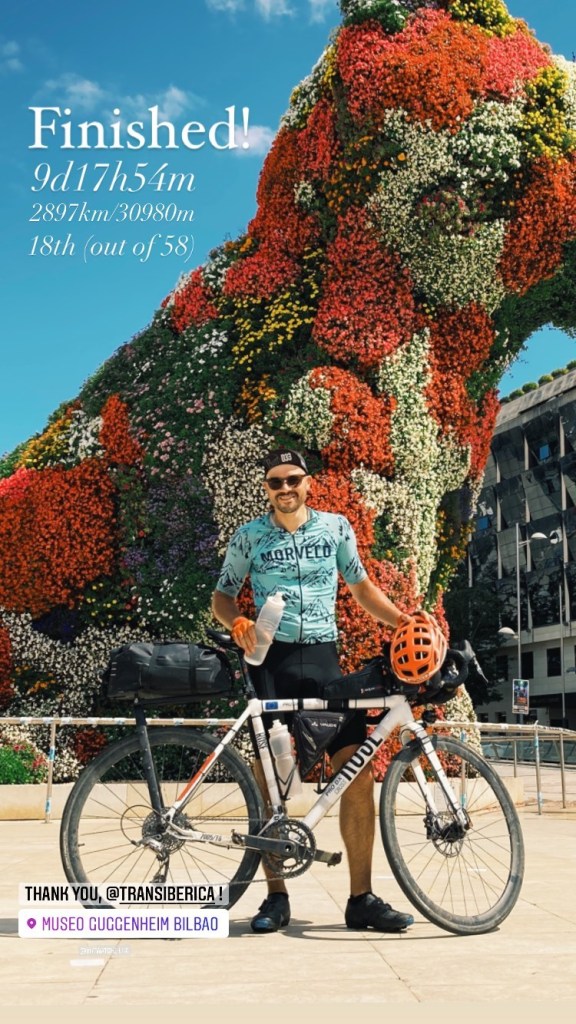
I certainly reduced my stopping time. I tried not to give in to the continuous itch to stop for another cold drink or ice cream. Also: I kept a healthy pace, and as mentioned I slept more, so my daily mileage increased. Over all my average daily mileage was 297km, so I just about missed my 300km/day goal, but I didn’t mind. Close enough. Average daily elevation gain was 3177m.

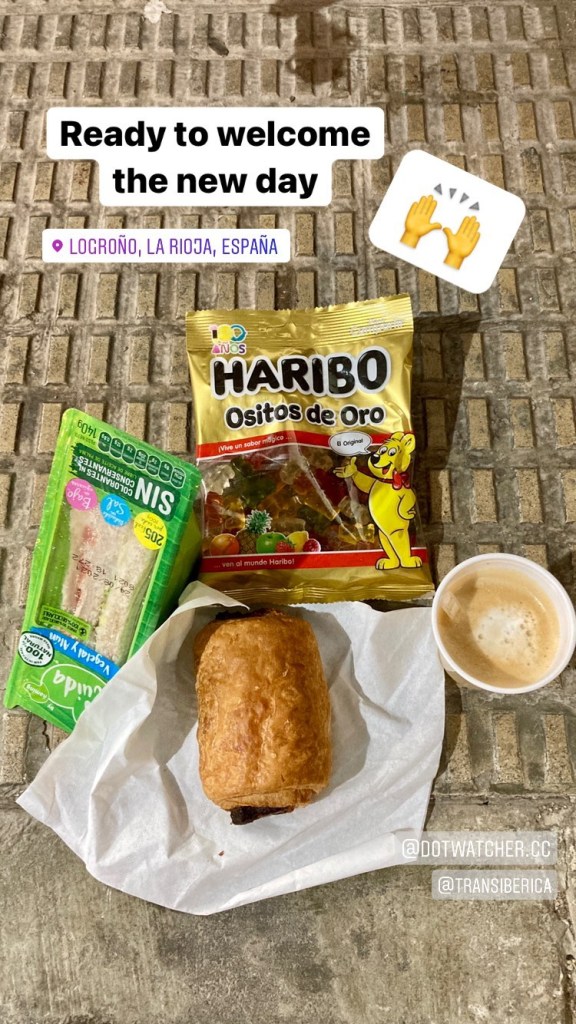
Apart from being more rested thanks to (somewhat) regular sleep, another positive factor was eating. Don’t get me wrong: I still ate mostly crap which is the perfect thing to do: calories, carbohydrates, some protein, salt… the body doesn’t care where exactly those basic ingredients are coming from. What I did better was: i ate more frequently/continuously. Constantly taking a handful from my food pouches that I had placed between my aerobars: Haribo, M&M peanuts, Cliff-Bar (I brought many of those, love them), Chips. Even some fried pork skin that they sell in Spain and somehow appealed to me, hah. And of course occasional café stops, proper meals, sandwiches, many gas-station stops with the obligatory half liter Coke and icecream. That worked well. next time I should just eat a bit more.

Focus more on enjoyment, moments, people, places

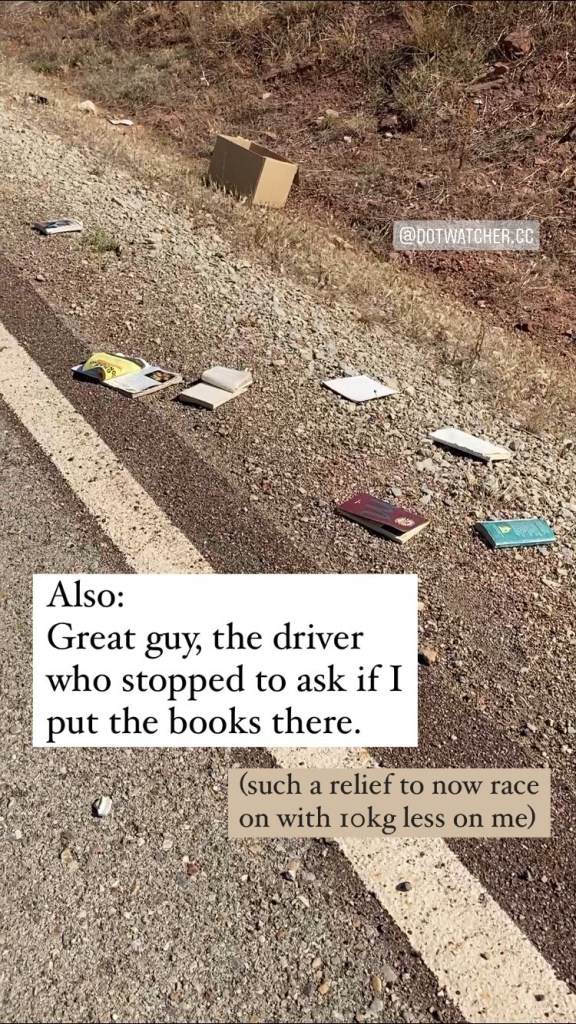
Definitely worked! I was in great contact with other riders. Everyone in this scene seems to be kind – I realized that again. Additionally I tried to be as receptive and observant as possible for all things around me on my trip. Weird moments like where I found dozens of books spread all over the road, or the kind employee of the rural supermarket with who I communicated through gestures only, who handed me two cold pieces of watermelon on a 42°C day. The forest that had burnt down, was all black and still smelled like a camp fire… what a view and vibe. Being heavily chased by pair riders Richard & Sam Gate (father and son) on the last 180km, and arriving just 8min (in a 10-day-race!) ahead of them. And many more unforgettable moments and experiences that I will keep in my heart, but not write down here.

Needless to say I also had my moments of negativity. Especially around the middle of my race I was fatigued and didn’t make the progress I hoped; several riders who had been around me for days were getting more and more ahead of me, which was frustrating to see. Apologies to everyone who was exposed to my fluctuations in mood. I overcame this negativity not so much through a change in mindset, but “simply” through improving my performance: with some big efforts in the last 3rd of my race where I checked Checkpoint 7 & 8 in one day and did a good bit of night riding. Anyway…

I also tried to capture some of my encounters, situations and moods on social media, mainly Instagram stories. I had many followers – maybe also you – who watched them with interest, engagement and interaction. This was a very important experience to me, because it may have made me more attentive, selective in my attention, and more reflective; I looked out for things and situations that I would like to show, reflected them and myself. On a 15-hour cycling day there’s plenty of time to think about what story to tell with what image or words.

Which leads us to…

03b) My race through the lens of my Instagram-Stories

I think both form and content of my Instagram stories this year are well suited to make them this years main feature to let you participate in my racing experience.

The form, because – as mentioned – my goal was to focus on the positive, special and on enjoyment, to be more observant and reflective. That is exactly what Instagram stories are in form: a selective representation of moments. I also wanted to focus more on the social element, and as a social medium (even though some doubt it) these stories were a form of communication that brought me closer to you or anyone who was interested in me and my race and to many people that I was interested in, too. Such a race is an opportunity to experience many productive facets of loneliness: being with oneself, self-reliant and self-aware. This social interaction with loved ones and strangers and loved strangers managed to remove many of the unpleasant elements of loneliness while preserving the productive ones.

The content-level of these Instagram stories is for rather obvious reasons suited for taking you with me on my race: they depict things that I saw and experienced; often accompanied with some text, to give context. And on a somewhat “meta” level: the way I designed the stories – some humorous & ironic, some plan or even boring – they tell something not just about their subject but also about my state of mind and mood and take on things in the moment.

So, without further ado…
CLICK HERE to go straight to my Story-“Highlight” in Instagram, containting 100 stories. (requires Instagram account)

For anyone without an Instagram account, I created this compilation of all 100 stories in one video (ca. 15 Minutes). It’s the same content, but you miss some of the usability features that Instagram offers (like pausing or skipping stories)

03c) Facts, figures, pictures & Strava tracks…

Map of my race

And now… first a map of my race. Better click this link to open a larger and better to navigate version of the map. You also find a preview below.

The map shows:

  • Start & Finish (Bilbao)
  • the 9 checkpoints in between & compulsory parcours per checkpoint
  • my individual route (the way I rode it)
  • sleeping locations & types

Stats overall & per stint

Race start:
Sat. 14th of August 2021, 22:00h at night
Bilbao, Spain, Guggenheim Museum

My overall stats:
2897km, 30980m
– daily average: 297km and 3177m
9d17h54min – 9 days, 17 hours, 54 min
– arrived on 18th position (out of 59 solo-riders at the start)

This means: in terms of daily mileage I almost reached my 300km-goal, and improved my performance by ca 25km. In the field I arrived on a similar position as in previous races, namely about top third of finishers, and top half of starters. This means that the field was stronger in this race overall compared to Trancontinental Race No. 6 and Three Peaks Bike Race 2019.
day0/day1 – f***ing up and catching up

https://strava-embeds.com/embed.js

(Strava) 14.8.21, 22:00h Bilbao to 16.8.21, 00:13h Xerta
Total distance: 518km
Total elevation: 3017m
Elapsed time: 26:13h
Moving time: 19:27h
Stop time: 25%
Sleep afterwards: bivy on local football pitch
Further remarks:
– Two personal records: longest distance in one go (518km) and longest distance within 24 hours (475km)
– light didn’t work at the start, so I had to fix it right when the control car released us; just outside of Bilbao stopped at a gas station to find the issue; turned out an extension cable I had soldered was shoring the circuit (of course I had tested the light before. It had worked). I was behind the field from that moment an. Also: picked an “exotic” route that left me way behind, so I was last. But during the day I slowly caught up (caught the first midfield riders around noon of the first day); the next morning I was already in the middle of the field at CP1.
Strava caption:
Phew… what a ride.
I fell back behind the main field early because of a less efficient routing choice (see screenshot among pics. Nr 33). But looking at my stats (not current placement) I’m incredibly satisfied. I think it will be a matter of days to have caught up more, hopefully this was not a 1-day performance.
Was tough though, obviously. Especially the desert parts at 42 degrees or so.
Also have a new Personal 24h-record: 475km
Now gonna sleep properly and climb CP 1 in the early morning.
Found a water fountain, have some cookies… so nothing can go wrong ; )

day2 – getting my bones used to it

https://strava-embeds.com/embed.js

(Strava) 16.8.21 Xerta to Barbastro
Total distance: 227km
Total elevation: 2898m
Elapsed time: 15:31h
Moving time: 11:43h
Stop time: 24%
Sleep afterwards: Hotel in Barbastro
Further remarks:
– Checkpoint (CP) 1 climed in the morning: 1400m up, with a view on the Mediterranean Sea
Strava caption:
Obviously shorter than yesterday. Was of course still exhausted from the long one, and had a cold few hours of sleep in the wind (was too lazy to get the bivy out), and also: this ride was opposite to the previous one:
– begann with a crazy long and quite steep climb in the morning (1400m), continued with several tedious climbs in the heat of noon
– route had a continuous incline
– headwind
only the torturous heat in the afternoon was equal.
Also, I feel my Achilles and knees (no problem, will go away. Always happens after the first big climb), so better not overdo it.
Wanted to have a shower and bed after 2 nights on the road, and charge my power bank, so got a cheap hotel room kind of on the route. Will get up early to do the last bit to CP2 and the respective Parcours, so I‘ll climb before the sun hits.
Greetings from Barbastro, Good night!

day3 – feeling well. climbing/descending took a lot of time. And: classic Nachtattacke : )

https://strava-embeds.com/embed.js

(Strava) 17.8.21 Barbastro to Cáseda
Total distance: 255km
Total elevation: 3800m
Elapsed time: 17:55h
Moving time: 12:58h
Stop time: 28%
Sleep afterwards: bivy behind some parked cars in a village shortly before the Bardenas desert
Further remarks:
– climbed CP2, descended westward on a gravel route. Rode until late into the night
Strava caption:
Overslept in the morning (original plan: 5am), but also needed it. My legs felt fine: as predicted: Achilles issues gone, knee issues almost.
The route towards the beginning of the Parcours was stunning! In and along a canyon. The Parcours climb to CP2 was doable: long, but reliably between 7-10%, however with my road tires had to sit all the way (otherwise no traction). The descent was hell. I opted to continue the path down to Torla; instead of backtracking. Heavy gravel, so: 1,5 hours of full tension, keeping the brakes tight, full focus to not hit the rocks wrong, at ca 10-15 kph.
From there on quite straight forward. One climb, then long countryroads, slightly descending but also headwind. Felt very fresh until late at night. My playlist (made by my friends) helped a lot! 💪
Now in my bivy in Cáseda. Until the end I was still in shape to move on
Good night!

Transiberica day4 – productive day 💪

https://strava-embeds.com/embed.js

(Strava) 18.8.21 Cáseda to Albarracin
Total distance: 319km
Total elevation: 2055m
Elapsed time: 15:36h
Moving time: 13:16h
Stop time: 15%
Sleep afterwards: hostel in Albarracin
Strava caption:
Slept 3 hours in my bivy. Then moved on; at first super tired and feared falling asleep on the 40k way to CP3 parcours … during the Parcours slowly woke up. After the Parcours the north wind picked up to help me push south. Had a very strong, continuous ride with not much stopping. Later the wind turned around so I really had to fight. Found a room in Albarracib by phone and then started a race against the thunderstorm. I womit by 10 minutes. 💪
My Achilles pain is gone. My knees hurt, but will probably be better tomorrow. Worried ore about my feet… they hurt a Lot towards the last 3rd of the ride.
Greetings from Albarracin!!

day5 – headwind and literal ups and downs

https://strava-embeds.com/embed.js

(Strava) 19.8.21 Albarracin to Riaza
Total distance: 288km
Total elevation: 3430m
Elapsed time: 16:21h
Moving time: 13:27h
Stop time: 17%
Sleep afterwards: bivy on lawn next to gas station on CP5 parcours
Strava caption:
By the way: I post frequent updates on Instagram as Malte Cyclingtourist.
Started at CP4 (Albarracín). At 22h arrived at the start of the CP5-Parcours and decided to still do the first climb of it.
First two thirds of the whole ride had headwind. And the elevation meters came through a constant up and down. Pretty tedious over all.
First third I was quite slow and had too many stops. Then changed my attitude and riding a bit, which worked.
Damn.. so tired, I’m falling asleep while typing this. Good night.

day6 – no flow

https://strava-embeds.com/embed.js

(Strava) 20.8.21 Riaza to Zapardiel de la Canada
Total distance: 280km
Total elevation: 3138m
Elapsed time: 18:46h
Moving time: 13:26h
Stop time: 28%
Sleep afterwards: bivy in rural bus stop
Strava caption:
Original idea was to get up and really push through to a 300+ ride. But was exhausted, stopped a lot, rode slowly. Hot, boring landscape (except Parcours), constant up and down… not motivating. Pushed on until late at night when I noticed I‘d fall asleep soon. Stopped in a village, slept in a bus shelter. Tmrw will be better.

day7 – Slow day, a lot of climbing. but then racing to the hotel

https://strava-embeds.com/embed.js

(Strava) 21.8.21 Zapardiel de la Canada to Fermoselle
Total distance: 248km
Total elevation: 3306m
Elapsed time: 16:16h
Moving time: 11:34h
Stop time: 29%
Sleep afterwards: hotel in Fermoselle
Strava caption:
The numbers don’t look impressive compared to other days, but: I’m super glad it turned out that way. At my arrival at CP6, 18:30h I had only 135k on the clock and was a bit frustrated about it. Since I wanted a hotel for the night I was so restricted in choices that it might have been a 170k-day. I found one last room at a distance I originally thought was too far. I raced there with (by my standards) super high pace (35kph most of the 75k Ride to the hotel) to be in time to get the keys. Made it 23:55 – 5min before homelessness.
So: yay, a hotel, and a day distance + elevation that’s really ok.
Even ended up having 3 Colas on a street festival that was going on when I arrived..
Good night!!

day8 – incl. CP7 & CP8 – up up up

https://strava-embeds.com/embed.js

(Strava) 22.8.21 Fermoselle to Lagunas de Somoza
Total distance: 261km
Total elevation: 4707m
Elapsed time: 18:38h
Moving time: 14:12h
Stop time: 24%
Sleep afterwards: bivy on side wall of little square
Further remarks:
– on that day I cycled into Portugal to CP7. The terrain was tough; hopping from from one river valley to the next. Portugal was like the “Hungary of Western Europe”
– moved on and did two more huge climbs, incl. CP8 where I ended on top exactly at midnight with Moon and Venus high in the sky. What a view.
– Then moved on and took a little gravel/rumble path off the road to skip over into the last end of a tiny valley. This move was risky as I had no idea if I’d successfully pass that wild stretch; but it ultimately saved me ca. 2000m of climbing, and the the next day I would mostly ride smoothly downhill or flat towards CP9
Strava caption:
Probably the most I ever climbed in one stint.
More text will follow later.

DAY9 long, hot & flat, then torturous CP9 climb in icy fog

https://strava-embeds.com/embed.js

(Strava 9a & Strava 9b) 23.8.21 Lagunas de Somoza to Siejo
Total distance: 321km
Total elevation: 2490m
Elapsed time: 18:28h
Moving time: 13:41h
Stop time: 26%
Sleep afterwards: bivy on a parking lot next to a river; cold valley
Further remarks:
– rode down the looong valley, country roads past León, ultimately to the edge of Picos de Europa
– downhill, and then up the challenging climb of CP9 where it was incredibly cold, rainy and foggy
– back down, and then as long as I could along the valleys eastward. at some points couldn’t keep myslef from sleeping but had a hard time finding a suitable sleeping spot because the river valley was so cold. ultimately found a parking lot and took shelter behind some container
Strava caption:

day10 to the finish line. Arrival: 14:54h

https://strava-embeds.com/embed.js

(Strava) 24.8.21 Siejo to Bilbao (Finish)
Total distance: 180km
Total elevation: 2123m
Elapsed time: 9:33h
Moving time: 7:46h
Stop time: 18%
Sleep afterwards: bivy on a parking lot next to a river; cold valley
Further remarks:
– after a few hours of sleep in that cold valley moved on. Sunrise over the Atlantic Ocean, finding some café
– overall took it rather easy and still had an efficient ride that day
– at some point by checking the live-GPS-tracks it dawned on: Richard & Sam Gate (father & son riding as a pair) who I had bumped into on the CP9 climb, were chasing me relentlessly. So for the last 70km over the hilly coastal roads with many tiring ascends, I really pushed it. After getting lost a bit in Bilbao I still arrived 8min before them! 8min! in relation to a 10-day ride. That was a close one.
Strava caption:
Yaay, finished! 🎉
For now:
– finished in 9d17h54m (=9,75d)
– as the 18th (of 59) rider
– total: 2897km and 30980m
(that‘s on average 297km/3177m per day)
I‘m incredibly happy with the result… not just because of the stats. But also because my riding style matured a lot, I managed to do it with more joy/less suffering and managed to also enjoy little things in between and: be connected with many of you! THANK YOU SO MUCH. Really, this kind of interaction matters a LOT in these otherwise lonely and very challenging days. Every support-emoji and comment counted and put a smile on my face.

To anyone who got this far..: Thank you! You’re a real ultra-cycling fancier. I appreciate your attention. And here’s a little heads up to you exclusive bunch: My next big thing will be the Transcontinental Race No. 8 in 2022. Start is on 24th of July in 2022, if you like, follow me on Instagram for regular (also smaller) updates. If you have any comments or questions, use the comment function here, or contact me via the contact form or via Instagram. Byeee!

02 Transiberica – Equipment & Packing List

You are at post 02 about my Transiberica Race in 2021. If you first want to know what it is all about, check my post 01, and if you want to know how it all turned out, you can check post 03:
01 Transiberica Bike Race 2021 – Live Tracking (Cap33) & About the Race
02 Transiberica – Equipment & Packing List
03 Transiberica – The very late post-race post

Yeeees, I know, kiddies… you want to know all about the gear and what kind of things I’ll bring on the Transiberica Bike Race. So here we go… First I’ll give you a quick text summary. Then point out a few items that I (ex)changed or added to my setup; further down you find a complete packing list. Plus some pics on the way…

This Year’s Bike and Setup

Of course: My Rose Pro DX Cross from 2015, but I just call her lovingly „Rose“ <3. Rose runs on Sram Force22 (disc) and has an alloy frame and carbon fork. Her custom compiled gearing of 46/33 (front) and 12-36 (rear) will hopefully get me up allll the climbs while still allowing me to pick just the right cadence/force at any point (no large gear jumps). For comfort, Rose is equipped with Continental GP5000 tubeless tires in 32mm, a Redshift ShockStop suspension stemProfile Design T4 aero bars, a Specialized Power saddle and gel pads under the bar tape. I decorated Rose with tons of reflective tape, but my favourite accessories are still: a little rear mirror and my beloved bell that is modestly hidden under Rose’s elbow pads. Sometimes it goes off accidentally and then it’s as if Rose and I were having a vivid conversation; yes, that’s how lonely it can get on the road sometimes.

Rose Pro DX Cross

WEIGHT:
– bike only: 10,8kg (without bags and rack, but including all adjustments like aero bars, dynamo, light/electronics, pedals etc…)
– bike with empty bags: 12,4kg (incl. Tailfin rack)
bike with luggage: 16,5kg (excl. food & water)

And some more kit…

This season’s kit colours are turquoise/orange for the summery Miamy look that I think will fit the Spanish heat. Additionally, I’ll bring a light pink merino Buff for that extra bit of quirky but homey living room flair and for its versatility (remove sweat from my eyes & warm my ears at night).

Morvelo summer jersey, LaPassione Duo Gloves Orange, Suomy Gun Wind helmet

My bedroom consists of a bivy, light mat & silk liner + boxers & shirt dedicated to clean sleeping. My Wahoo Elemnt (+ phone backup) in combination with a SON dynamo hub and Edelux II light will show me the way while an Igaro D2 USB-charger and a 13000mAh powerbank will make sure I never run out of juice. A carefully curated bike-mech/spare-parts compartment (incl. rear derailleur hanger & spokes) and babywipes/chamois cream/ointment will rule out most show-stopping technological or biological malfunctions.

The bags are arranged to reduce the frontal area (aero) and optimize accessibility: 2 food pouches in-line between the aerobars, a fuel tank and phone sleeve behind them, small frame triangle to still make 2x 1L bottles fit, and my newest acquisition: a Tailfin rack & trunkbag.

very small frontal area

What’s new? (gear-wise)

If you’re interested in my gear (well… you’re here), you can also check my post on my Transcontinental Race preparation in 2018 where I go through the reasoning regarding many of my gear choices. Here’s some more…

Tailfin luggage system

Like so many riders recently, I exchanged my standard-style seatpack (great working Specialized Burra, 10L) for a Tailfin setup (alloy, quick release trunk bag).

The advantages:
a) even more rigid construction than the Specialized Burra
b) much easier access (namely from top) and handling (quick release)
c) larger volume
d) slightly lower center of mass

This allows me to store all luggage incl. sleeping gear in the back and therefore do without a drybag strapped under my aero-bars = less weight on the handle bars.
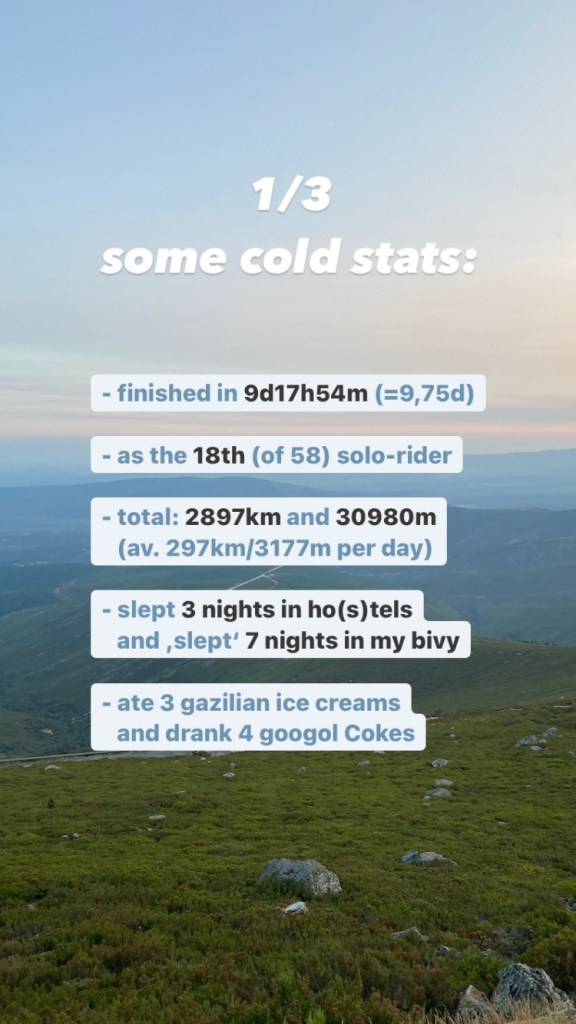
Tailfin Alloy trunkbag & rack http://www.tailfin.cc

Position of food pouches

Now with the aerobars free, I moved my 2 food-pouches (Revelate Designs) in-line between the aerobars. Previously they were mounted left and right behind the handle bar under the elbow pads.
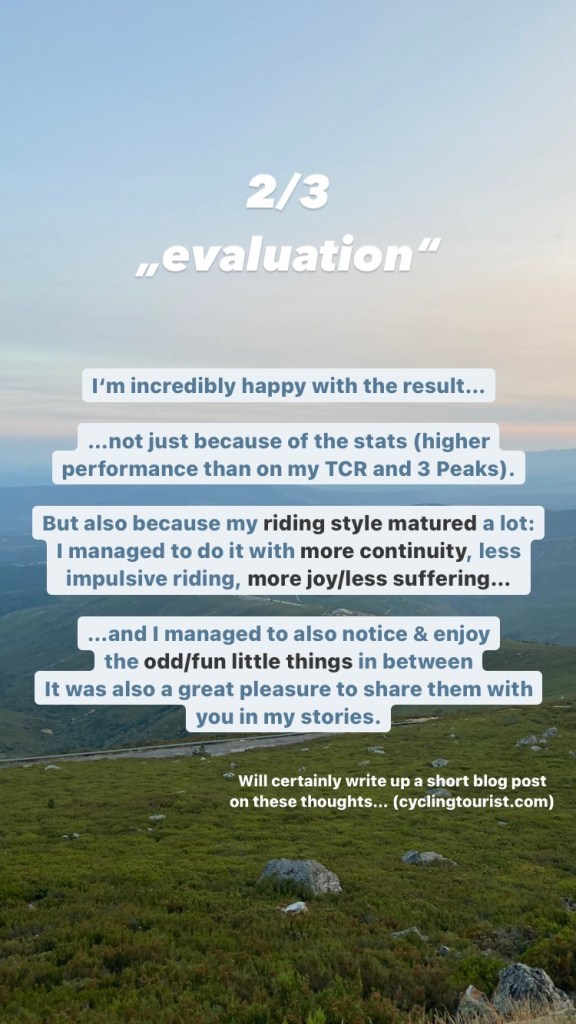
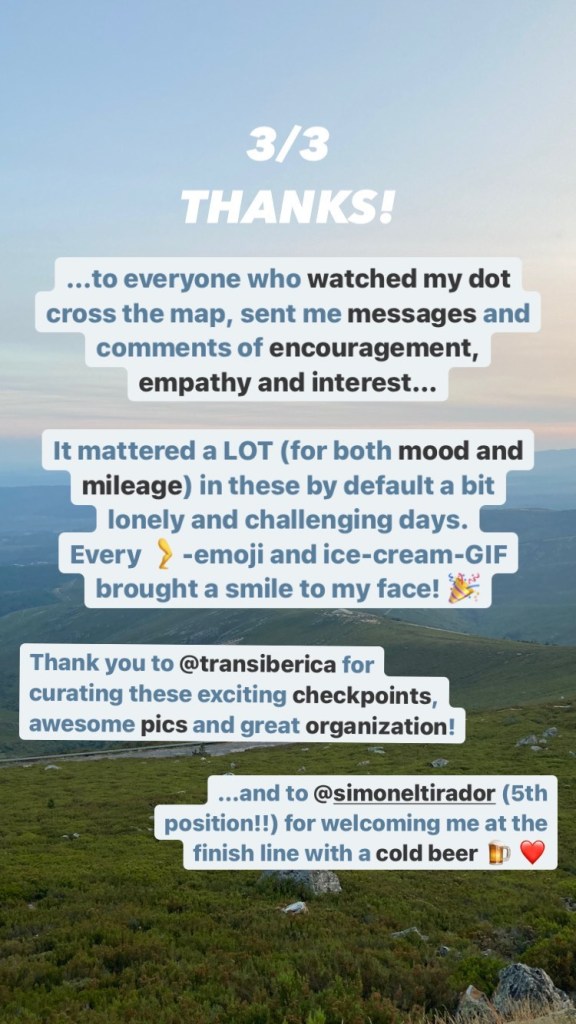
The advantages now:
a) easier access
b) a smaller frontal area (more aerodynamic; yes, it does matter)
c) simply a much tidier cockpit (matter of aesthetics)

Cockpit with two Revelate Designs Feed Bags between the aero bars

SPD shoes/pedals:

I switched from SPD-sl (road system) to SPD (MTB system). This was because I needed new shoes anyway (got numb toes in my otherwise excellent Shimano S-Phyre) and to be more flexible and worry less about my shoes in case I have to walk small gravel/rubble sections. At the same time it also makes the shoes more practical in any situation off the bike.
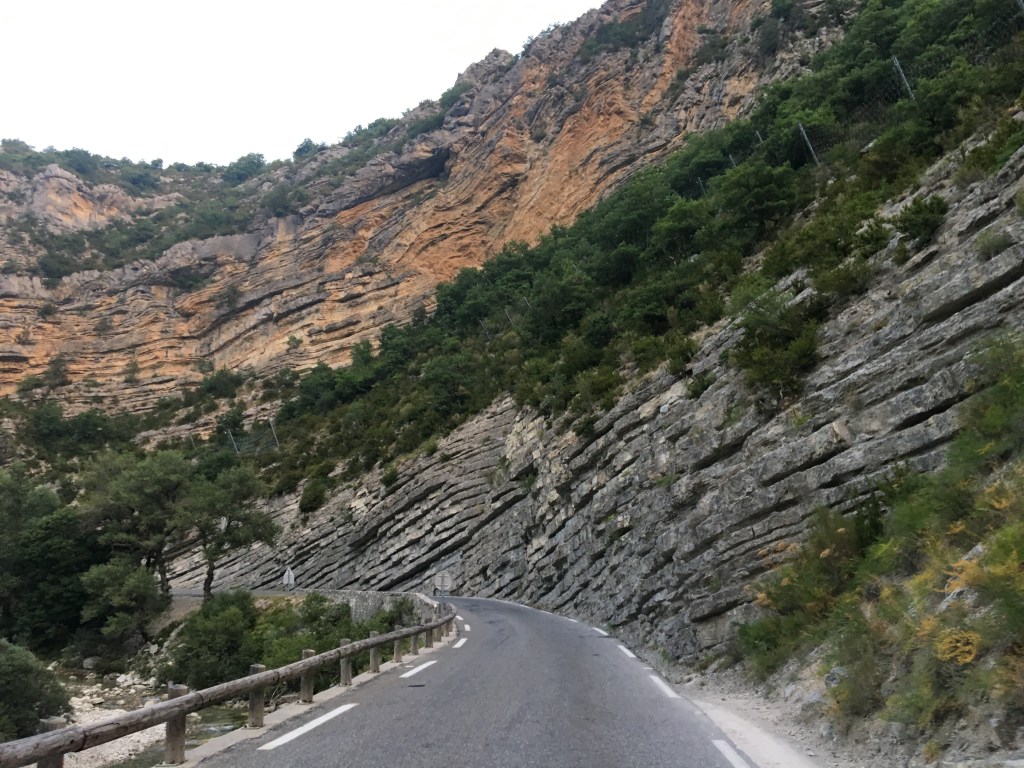
Even though they are the most expensive option, I opted for Shimano XTR pedals because the have the lowest stack height and I hope it will get closest to the feel of a road-system. Even if the effect is rather psychological than mechanical: I wouldn’t want to put pressure on the pedal and have the feeling my foot wants to rotate around the pedal axis because it is (or feels) too high above it.

For shoes I got the Shimano XC7 as I really liked my previous Shimano shoes (S-Phyre), and they have a “wide” (larger volume) version. They are very stiff (didn’t want to risk feeling the smaller contact surface of SPD) and have a moderate bottom profile and are overall rather clean looking and “racey”. To allow for better air ventilation in the hot Spanish summer, I added some larger holes with a pair of hole punch pliers (Danke, Rainer Zeller für Idee und Zange!); the result looks good, but I didn’t test it; fingers crossed.

Shimano XC7 shoes

USB dynamo charger igaro d2

After a lot of disappointment with the Plug5 Plus by Cinq (very cumbersome installation and failed immediately in the rain) I needed a new device. After consultation of other riders in the scene, I opted for the UK-made Igaro D2. Admittedly there were some issues with the batch of units at first; but Igaro customer support is phenomenal, and ultimately they managed to sort everything out and now I have a well working device.

I mounted it on top of my Redshift Rockstop stem. I made sure to let the cables enter/exit without making the sockets vulnerable to the elements and fixed everything with cable ties. Now I have a USB outlet going straight into my fuel tank bag; perfect.

Igaro D2 USB charger for charging devices from the dynamo.

Lighting: son edelux ii

I had made this adjustment already 1,5 years back, right after my Busch&Müller IQ-X lamp failed again in the rain on my Three Peaks Bike Race 2019. The IQ-X’s beam is absolutely perfect and incredibly powerful. But its housing and general build is disappointingly flimsy. So instead I went for the crème de la crème: SON Edelux II (and rear-light), i.e. the same manufacturer as my high-end SON dynamo hub. The beam is fantastic (just not as great as IQ-X), but especially: it’s super robust and water tight. Additionally I installed everything with sturdy SON coax cables and properly soldered in some plugs. To allow myself to fix the rearlight to the Tailfin rack, I added an extension cable at the back and also built simple fixtures to attach the rearlight to either the tailfin or the frame directly. In the whole coax cable routing I also included a little split-box to neatly plug in the power-chord for the Igaro D2 USB charger. I’m incredibly satisfied with this lighting setup.

SON Edelux II connected to SON dynamo hub

Cockpit bags: Fuel Tank & phone sleeve

I really liked my Blackburn Fueltank bag; but after so many years and heavy use, the zipper failed. Decided to go for something slightly more compact, and with the zipper positioned in a way that I guess makes it less prone to failure: The Revelate Designs ‘Gas Tank’. Really like it; it’s very stable on the top tube, and access is perfect.

Additionally I got a separate Tatonka phone pouch that I velcro-tied to the side of the stem. Admittedly it doesn’t look great, but it’s super functional, aero, and good use of that space in the cockpit. Now I can more easily access the phone for quick photos etc.

Revelate Designs Gas Tank & Tatonka phone sleeve

smaller chainring: 33T

Changed the smaller chainring from 34 to 33 teeth (by TA Specialties), i.e. even slightly lighter gearing than I had already. So my geating is: 46/33 in the front and 12-36 in the back (custom cassette). Probably that 3% difference will not be so significant. But it’s the smallest I can go on my crank, and the surprising side effect: shifting is much smoother now. My 46T chainring (Sram) is designed to work best together with 36. My former 34 chainring consequently didn’t shift so smoothly. But the combination with that 33 ring does a perfect job for some reason.

Redshift suspension Stem

I now ride a Redshift suspension stem: it’s essentially a stem that has some rubber inserts that allow for a slight suspension. It is hardly noticeable, which is great because: originally I feared it might feel too soft/uncontrolled, but that’s not an issue at all. Essentially I simply notice that I’m willing to stay in the aero bars on even slightly bumpy road surfaces. So: overall it’s less tiring on hands and arms, without any compromises on a solid steering feel.

Wheels: DTSwiss custom build

Nothing fancy, but works very well: I got these wheels built already 1 year ago. Simply because the rims of my old set were done. They were built by Reinald of Komponentix in Berlin; had to be custom built because I wanted my SON dynamo in stable rims. Overall really sturdy wheels and very affordable (620€ excl. SON hub). Removed all labels, and they look fantastic.

The components are:
– rims: DT Swiss RR521 db. Aluminium, deeper section, affordable
– front hub: SON dynamo (had this one already)
– rear hub: DT Swiss 350 Road db CL. It’s heavenly quiet ❤

Hiplok Security Tie (“lock”)

Previously I used an Otto Lock.Now I felt it is too bulky in comparison with how much it protects the bike (namely: hardly). Instead I got a Hiplok Z Lok Combo, as it gives equally little protection, but packs smaller.

Packing List

Documents

  • ID card
  • hardcopies of documents (incl. Corona stuff)
  • health insurance card
  • contact details
  • pay cards
  • some cash

Electronics

  • iPhone SE
  • Wahoo Elemnt (updated & with routes)
  • headphones Sennheiser bluetooth
  • USB charging cables: 2 micro, 1 C
  • Anker USB charger (4 ports)
  • Anker power bank 1300mAh
  • iPhone cables, 1 short & 1 long

Bike maintenance

  • mini leatherman (no name)
  • multi tool (Lezyne)
  • air pump (Lezyne, with digital pressure gauge)
  • extensive puncture set (incl. tubeless plugs etc.)
  • 2 tire levers
  • piece of old tire
  • cable ties (many!!)
  • shoe lave & thin thread
  • Sram chain link
  • rear derailleur hanger
  • gear inner cable
  • chain lube (Squirt dry lube)
  • replacement spokes & nipples
  • 2 pairs of brake pads
  • schrader valve adapter (to use gas station pumps)

(Spare) clothes

  • Buff merino multipurpose head scarf
  • spare socks (Assos summer socks)
  • spare bib-short (Rapha basic)
  • spare base layer (LaPassione summer)
  • merino arm warmers (Mavic)
  • white UV protection arm sleeves 50+ (Castelli)
  • down vest (Endura)
  • rain jacket (Endura)
  • high visibility vest
  • boxershorts (for sleeping)
  • T-shirt (for sleeping)

Hygiene

  • toothbrush (cut off, obviously ; ) ), toothpaste, shampoo
  • Ibuprofen
  • wound healing cream (Bepanthene)
  • baby wipes
  • tissues
  • chewing gums
  • chamois cream
  • sunscreen 50+ (for babies, like me)
  • micro fibre cloth (for glasses)

Sleeping gear

  • silk liner
  • sleeping mat (Thermarest ultralight)
  • bivy bag (MSR AC bivy)

Miscellaneous

  • 2x 1L-bottles
  • Hiplok (small cable tie lock, number lock)
  • spork
  • mini backpack (Decathlon)
  • light plastic bag (to separate clothes, sleeping gear etc.)

Wearing

  • helmet (Suomy Gun Wind)
  • Glasses: Adidas Proshift with photochromic prescription lenses
  • short gloves (LaPassione Duo Gloves; light padding)
  • bib-short (Rapha basic)
  • short jersey (Morvelo summer)
  • base layer (LaPassione summer)

01 Transiberica Bike Race 2021 – Live Tracking (Cap33) & About the Race

You are at post 01 introducing you to my Transiberica Race in 2021. There are two more posts about the preparation and gear (02), and about how it all turned out (03):
01 Transiberica Bike Race 2021 – Live Tracking (Cap33) & About the Race
02 Transiberica – Equipment & Packing List
03 Transiberica – The very late post-race post

Yaaay, something new is coming up! After The Transcontinental Race got postponed one more time to 2022, I managed to get a late placement in the Transiberica Bike Race. Start is on Sat. 14th of August 21.:00h in Bilbao, Spain, and of course it’s with live tracking and followed on social media.

Transiberica facts & figures:

Transiberica is a (attention please…) self-supported free-route roundtrip ‘ultra’-endurance single-stage bike-packing time-trial in the spirit of Mike Hall†. That means…

  • Start & Finish: Bilbao, Spain
  • Start time: Saturday, 14th of August 2021, 21:00h
  • 9 Checkpoints (CPs) all over northern Spain to be approached in ascending order. Starting in Bilbao the course goes clock-wise.
  • free route choice, except for compulsory parcours at 5 of the CPs
  • ca. 2.900km and 38.000m cumulative climbing
  • self-supported, i.e. carry your own luggage, no outside assistance, no supply pre-arranged
  • single-stage, i.e. the clock never stops; there are no fixed stages or stops, neither for sleeping
  • 65 participants (6 riding as pairs), all genders competing in the same category
  • more detailed rules: see here

>>Here’s a link to a map to check the CPs in detail.<<

How to follow the event and me (realtime)…

Despite the geographical spread of events, endurance bicycle racing is a spectator sport. Each rider has their own GPS-tracker:

Additionally it is vividly accompanied on social-media

I’m always happy to hear from you. Encouraging messages, cheering, etc. are highly motivating (also to the other riders!). I may not always be able to reply immediately, but be sure I read messages and mentions with great pleasure!

03 TPBR – Race Summary

Here’s a very late summary of my 2019 Three Peaks Bike Race (TPBR); rather for the sake of completeness. And who knows, maybe there’s someone out there – a future TPBR rider or the like – who has some use for it. If you’re new to this blog and are looking for some more exciting and complete representation of my riding and racing, you may e.g. wish to check out my visual Transcontinental Race report.
In this current post I’ll simply provide you and myself with some facts and figures of my 2019 race. I also added my short Strava descriptions of each ride, but obviously they don’t do justice in any way to the richness of my TPBR experience and the hundreds of situations and encounters I had, good and bad.

If you first want to find out what the race is all about, better start here:
01 TPBR – This year: Three Peaks Bike Race
If you want to find out about my preparation, check this: 02 TPBR – What I changed: Equipment & Racing Approach/Behaviour

Below you find some data and visual impressions on a daily basis. At the end you find a few overall stats. I should mention that during the 8 weeks leading up to the race I couldn’t do any sports due to a broken finger that I didn’t want to risk; I’m very content with my race performance given these circumstances, but hope to perform better next time with more preparation.

Here you find a map of my recorded GPS tracks. For better usability, follow this link.

Day 1, Vienna – Linz

Start: Sat. 20. July 2019, 16:00h, Vienna, Austria
185 km, 1.110 m
Moving time: 7:10 h
Elapsed time: 8:45 h
Stopping time: 18%
Average speed: 26 kph
Finish: Sun. 21. July 2019, 00:45 h, Hörsching shortly behind Linz (Austria)
Sleep (end of stage): front roof of commercial building

Went quite smoothly. Had to stop once to sort out issues with my Wahoo Elemnt map display. Around 1:00 am at night a thunderstorm came up. Good timing to try to get some rest under the front roof of some commercial building. Surrounded by a raging storm. Didn’t really sleep. But was no other option really.

Thunderstorm while sleeping in Hörsching after Day 1, ca. 1 am at night.

Day 2, Linz – Haiming

Start: Sun. 21. July 2019, 05:37 h, Hörsching, shortly behind Linz (Austria)
313 km, 2.396m
Moving time: 13:10 h
Elapsed time: 18:10 h
Stopping time: 27%
Average speed: 24 kph
Finish: Sun. 21. July 2019, 23:50 h, Haiming (behind Innsbruck, Austria)
Sleep (end of stage): Hotel

Dear diary, 

I had deliberately set my GPS track to a destination far beyond what I deemed realistic; just to give myself something to push towards. Surprisingly I managed to get there – despite the first 100km in the rain. 

I fell behind the field because I was one of the few who decided to have some sleep in the first night (yes, I learned from my TCR mistakes). But today I fought myself back to the front of the midfield. Surprising. 

Not surprisingly I‘m getting tendon issues due to that sudden spike of activity (there was rediculously little training) – I will set my cleats back to the middle of the foot before climbing stelvio tmrw, to relieve my Achilles’ tendons. 

Wonder where I will end up tomorrow; I.e. if I have to pay the bill for todays effort or if my legs are just getting started…

Strava entry, day 2

Day 3, Haiming – Lago di Como

Start: Mon. 22. July 2019, 07:17 h, Haiming (behind Innsbruck, Austria)
269 km, 3.377 m
Moving time: 13:10 h
Elapsed time: 18:45 h
Stopping time: 30%
Average speed: 20,5 kph
Finish: Mon. 22. July 2019, 23:50 h, North-Western shore of Lago di Como (IT)
Sleep (end of stage): park bench

I‘m exhausted.

Strava entry, day 3
Descending from Reschenpass
Climbing Stelvio with Music (Art Farmer – Modern Art)
Descending from Stelvio (westbound)

Day 4, Lago di Como – Torino

Start: Tue. 23. July 2019, 08:43 h, North-Western shore of Lago di Como (IT)
235 km, 973 m
Moving time: 10:30 h
Elapsed time: 14:50 h
Stopping time: 29%
Average speed: 22,5 kph
Finish: Tue. 23. July 2019, 23:33 h, shortly behind Torino (IT)
Sleep (end of stage): campsite

Heavy heavy… especially with over 40 degrees in the Italian flatlands. 

Big climb tomorrow..

Strava entry, day 4

Day 5, Torino – Sault

Start: Wed. 24. July 2019, 07:26 h, shortly behind Torino (IT)
281 km, 4.350 m
Moving time: 15 h
Elapsed time: 29:30 h
Stopping time: 49%
Average speed: 19 kph
Finish: Thu. 25. July 2019, 13:01 h, Sault (Provence, FR)
Sleep (end of stage): launderette

I extended the ride through the night. Very ineffectively. But felt extremely uncomfortable in my dirty kit. And needed to change to my better bibs. Destination was Sault where there was a Laundromat. 

Tired.. we’ll see how the rest of the day goes.

Oh and… It’s my birthday.

Strava entry, day 5
Climbing the Colle delle Finestre with music
Approaching the Lac Serre Poncon around sunset
Pedaling…

Day 6, Sault – Sète

Start: Thu. 25. July 2019, 13:43 h, Sault (Provence, FR)
197 km, 397 m
Moving time: 8:45 h
Elapsed time: 10:50 h
Stopping time: 19%
Average speed: 22,5 kph
Finish: Fri. 26. July 2019, 00:35 h, Sète (Mediterranean Sea, FR)
Sleep (end of stage): hostel

Got my legs and my brain back. My very long but necessary break in Sault (eating, washing clothes, spending time deliberately aimlessly) took until ca. 14:30h. Considering that I’m quite content with these 196km even though it is far below what I want as a daily average. 

I cycled with very few stops and continuous pace. And even the land bridge before Sete was open and worked out great. 

Listened to the Podcast “Zeit Verbrechen”… kann ich sehr empfehlen!!

Strava entry, day 6
First time Mediterranean water

Day 7, Sète – Ax Les Thermes

Start: Fri. 26. July 2019, 08:18 h, Sète (Mediterranean Sea, FR)
223 km, 2.497 m
Moving time: 11:30 h
Elapsed time: 14 h
Stopping time: 18%
Average speed: 19,5 kph
Finish: Fri. 26. July 2019, 22:20 h, Ax Les Thermes (Pyrenees, FR)
Sleep (end of stage): hotel

Rain & Achilles pain

Strava entry, day 7
Approaching the Pyrenees with the occasional heavy rain shower

Day 8, Ax Les Thermes – Spain

Start: Sat. 27. July 2019, 09:17 h, Ax Les Thermes (Pyrenees, FR)
150 km, 3.315 m
Moving time: 8:45 h
Elapsed time: 12:30 h
Stopping time: 27%
Average speed: 17 kph
Finish: Sat. 27. July 2019, 21:53 h, shortly behind Spanish border (Pyrenees, SP)
Sleep (end of stage): hotel

Rough day for me. 

First overslept, cause I forgot to set an alarm. 

Then pouring rain almost constantly. Lots of climbing (two big passes) and obviously colder with every gained meter of altitude. Then after 1h of climbing realized I forgot my wallet in the hotel. Back down and back up in the rain. – while being soaked. and even colder when in that state you descend: further cooling wind and no work to keep you warm. 🥶 after the descend from arcalis Ordina I kept shivering for 30min in some café. 

Checkpoint 3 (last one) done. 

But a great conclusion: Found a fabulous little hotel just behind the border in Spain. 

Dialogues you never hear: „Where shall I put my bike?“ – „I suggest you just take it on the room.“. Here that actually happened ❤️

Strava entry, day 8
Singing in the Rain – On Arcalis Ordina

Day 9, Andorra – Barcelona

Start: Sun. 28. July 2019, 06:42 h, shortly behind the Spanish border (Pyrenees, SP)
220 km, 3.369 m
Moving time: 10 h
Elapsed time: 11 h
Average speed: 22 kph
Stopping time: 9%
Finish: Sun. 28. July 2019, 17:41 h, Barcelona (SP)

Finished Three Peaks Bike Race on Sunday, 17:40h after 2100km/22000m/8days. 

Wow… today I was on fire. Started at 7 and basically went through without a break. I took over 3 other racers who got up much earlier and had a headstart of at least 50km. Very satisfied. Also overall: with this trip I doubled my yearly mileage 😂 – involuntarily there was hardly any training. So, i‘m quite astonished I managed to finish at all. 

At the finish line I was sprayed by Rainer with sparkling wine and treated with a cold beer. Thanks SO much! 

Thank also to YOU followers for your interest and messages of encouragement. It was highly motivating to know I was not alone on the road.

Strava entry, day 9
Cycling through a canyon
Approaching Montserrat on the final parcours

Overall…

Total distance: 2073 km
Total elevation: 21784 m
Total time: 8 days, 1 hour, 45 min
Stopping time (weighted): 27%
Daily mileage: 260 km
Daily elevation: 2723 m
Sleeping: 4x Hotel/Hostel, 4x bivy/other/none

Lessons learned…

A) I should reduce the stopping time (27%) by a lot. E.g. bringing it down to 10% could increase my daily mileage by 40 km to 300 km/day
B) a ride/sleep rhythm by day/night works. I should even more fight the impulses to ride on at night.